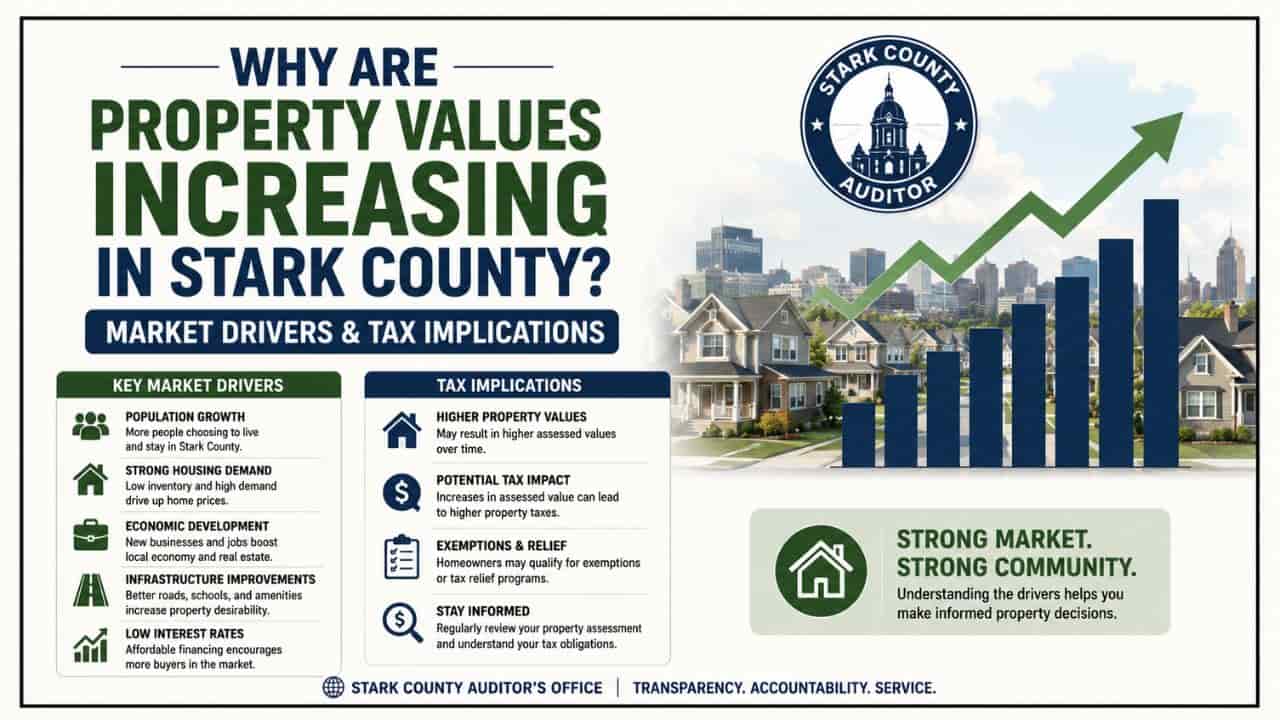
Performing an address search through the official Stark County Auditor’s portal is the critical first step for homeowners, buyers, and investors to access verified public records in Ohio. This government utility provides instant, institutional grade data directly from the county registry, bypassing the typical lags and inaccuracies found on third-party real estate platforms. This comprehensive guide outlines the exact, technical steps required to navigate the Stark County Real Estate Portal, ensuring absolute compliance and clarity for your real estate data extraction.
Example
Parcel Number: 2117023000020
Owner Name: Golden Field Farms
Address: 7810 Jericho Rd
By using the official Stark County Auditor property search tool, you avoid relying on third-party sources that may have outdated or inaccurate information
The Structural Importance of Verified Public Records Search
Understanding the complex administrative landscape of Ohio real estate requires reliable reference points. The values established by the county appraiser directly impact municipal funding, school district allocations, and individual annual tax liabilities. Accessing this information strategically resolves multiple title and investment risks before finalizing any transactional agreements.
Critical Use Cases for Property Data Verification
- Verification of Legal Ownership:
Validates the current deeded owner of record, preventing fraudulent title claims and verifying corporate or individual entity structures. - Assessment of Valuation Integrity:
Discloses both the historical market value and the assessed taxable value, which forms the numerical baseline for municipal tax levies. - Identification of Structural Dimensions:
Provides exact mapping indicators, land acreage calculations, and structural square footage metrics directly from verified GIS sources. - Analysis of Historical Tax Delinquencies:
Reveals current payment status, outstanding financial liens, special assessments, and systemic tax adjustments.
Expert Regulatory Note: In the state of Ohio, property tax assessments are updated on a strict triennial and sexennial schedule. Relying on outdated data from secondary aggregate web tools can result in severe financial miscalculations during closing procedures.
Step by Step Guide to Executing a Property Search by Address
The Stark County Auditor provides an advanced web interface engineered to query the centralized property registry. To complete an accurate search by address, users must conform to specific data entry syntax patterns to match the indexed county database records efficiently.
Step 1. Accessing the Authoritative Portal Interface
Initiate the process by navigating directly to the official digital portal managed by the Stark County Auditor (starkcountyauditor.org). Locate the main real estate portal navigation system, and select the specific query engine designated for “Property Search by Address”. This interface directly queries the live database containing real-time modifications made by the county administrative staff.
Step 2. Implementing Standard Data Entry Formats
For optimum database performance and to prevent null system responses, apply the following data constraints when entering address criteria:
- Input the precise house number or directional prefix (e.g., North, South) into the primary field.
- Enter the official street name without appending unnecessary punctuation or abbreviations unless explicitly required by the portal context.
- Omit generic suffixes such as “Boulevard”, “Avenue”, or “Street” if the search returns multiple options, as the system utilizes auto-fill data tables to isolate matching configurations.
- Specify the exact municipal township or city jurisdiction within Stark County to narrow down identical address structures across different geographic zones.
Step 3. Extracting Core Property Metrics from System Outputs
Upon clicking the execution command, the portal will generate a structured ledger containing critical variables. To evaluate a property thoroughly, experts systematically inspect the following core thematic sections displayed within the digital dashboard.
| Data Section Title | Primary Target Variables Found | Strategic Analytical Utility |
| Summary & Ownership | Deeded Owner Name, Mailing Address, Parcel ID Number | Confirms legal identity of titles and establishes formal points of contact. |
| Valuation Data | Appraised Land Value, Assessed Improvements, CAUV Status | Establishes the mathematical baseline for real property tax calculations. |
| Tax & Payment Status | Annual Tax Levy, Special Assessments, Delinquencies | Identifies financial liabilities and structural encumbrances on the asset. |
| Card & Building Data | Year Built, Total Square Footage, Structural Grade | Validates physical components against physical on-site observation records. |
Step 4. Leveraging Advanced GIS and Historical Toolsets
Beyond basic ownership parameters, the Stark County Auditor interface integrates Geographic Information System (GIS) mappings. Advanced researchers click the spatial map links to review exact parcel boundaries, topography layers, and adjacent municipal setbacks. Additionally, historical transfer logs allow you to track prior transactional values, providing deep context regarding local market trajectories and previous corporate or private hands that held the deed.
Advanced Optimization Data Frameworks
When performing institutional analysis, specific mathematical variables dictate the overall financial health of a property investment. For instance, the relation between the Total Market Value ($V_m$) and the Taxable Assessed Value ($V_a$) in Ohio is governed by a statutory percentage:
Va = Vm x 0.35
This means that your taxable baseline is exactly thirty-five percent of the county’s determined market value estimate. Understanding this computational metric prevents unexpected surprises when local millage rates are adjusted during public voting cycles.
Practical Tips for Eliminating System Search Errors
- Isolate the Parcel ID.
If an address query fails due to complex municipal naming conversions, locate the property on the county GIS map first to extract the definitive 13-digit alphanumeric Parcel ID. - Verify Multi-Unit Frameworks.
For commercial spaces or condominiums, ensure you check for individual unit numbers or sub-parcels appended to the parent address directory. - Cross-Reference Ownership Names.
If looking up by owner, utilize the “Last Name First” data protocol (e.g., Smith John) to align perfectly with the Auditor’s indexing configuration.
Conclusion
Performing a property search by address through the Stark County Auditor Ohio tool is essential for anyone needing reliable property information. It saves time, provides accurate and official records, and supports important decisions for buyers, sellers, and researchers. By using this tool, you ensure you are working with verified data, reducing the risk of errors in property transactions.
FAQs
Is there a processing fee to access the Stark County Auditor property search tool?
No, the digital real estate portal is a public utility funded by county administrative allocations. There are no fees or mandatory registration protocols required to access general address or tax valuation history.
How often are the property records updated on the official Stark County portal?
The internal databases are maintained daily by the Auditor’s structural division. However, external deed transfers and newly recorded property liens may take several business days to cycle completely through the county processing system.
What steps should I take if I detect an error in structural data or value assessments?
Stakeholders who identify discrepancies in square footage or current valuations should contact the Stark County Auditor’s administrative office directly to file a formal inquiry or request a formal review through the Board of Revision (BOR).
Can I look up property data using mobile electronic devices?
Yes, the Stark County digital platform is optimized for modern mobile browsers, allowing researchers, inspectors, and contractors to perform active, real-time address validation while on-site