
Understanding Ohio real estate closing costs requires a precise calculation of local administrative fees. When transferring property ownership in Stark County, a mandatory statutory transfer tax known as the conveyance fee is triggered. Whether closing on a Canton home or structuring a commercial mass acquisition in Massillon, verifying this transaction expense with absolute accuracy is vital. The Stark County Conveyance Fee Calculator simplifies this compliance process. By instantly checking sale prices against mandated state tax codes, this premium utility ensures your final closing figures align perfectly with the Stark County Auditor.
Stark County Conveyance Fee Calculator
What Is an Ohio Conveyance Fee? (The Legal Framework)
Under the Ohio Revised Code (ORC), a conveyance fee is a mandatory state-defined fee levied upon the transfer of real property deeds. The fee represents a form of excise tax collected by the county auditor before a deed can be officially recorded by the county recorder. While the state of Ohio establishes a baseline framework for this tax, individual counties possess the statutory authority to pass local permissive taxes to fund regional operations.
Stark County utilizes a blended fee schedule that combines both the mandatory state fee and a local county permissive tax option:
- State Minimum Fee Baseline: $1.00 per every $1,000 of the total real estate sale price.
- Stark County Permissive Levy: $3.00 per every $1,000 of the total real estate sale price.
- Combined Statutory Rate: A total of $4.00 per every $1,000 of the determined purchase price.
A critical operational rule mandated by Ohio tax law is the concept of rounding up to the nearest thousand dollar increment. Even if a property transaction exceeds a thousand-dollar unit by a single dollar (e.g., a final purchase price of $250,001), the administrative system automatically rounds the calculation upward to the next full $1,000 unit ($251,000).
Why You Need a Dedicated Conveyance Fee Calculator
Computing closing costs manually introduces multiple vectors for accounting errors that can derail an active real estate settlement. Using a dedicated calculation utility minimizes compliance risks for title companies and private stakeholders alike.
The Risks of Incorrect Transfer Tax Projections
- Rejected Filings and System Delays.
If a deed is submitted to the Stark County Auditor with an incorrect conveyance payment, the administrative staff will reject the filing immediately, potentially causing missed deadlines or contract breaches. - Escrow Account Discrepancies.
Minor rounding errors can create financial shortfalls in title company escrow ledgers, forcing title agents to delay the closing to request additional funds from buyers or sellers. - Multi-Parcel Multipliers: Commercial property packages and vacant land purchases often combine numerous distinct parcel numbers within a single deed, creating complex multi-layered fee conditions that require automatic data auditing.
How the Calculator Computes Real Estate Transfer Costs
The operational backend of the calculator translates official Ohio Revised Code rules into error-free mathematical outputs using a structured data segment framework.
| Database Input Segment | Specific Variables Processed | Strategic Analytical Utility |
| Parcel Count Index | Total number of discrete land parcels included in the deed transaction. | Ensures the cumulative multiplier is applied across combined real estate assets. |
| Sale Price Variable | The gross financial consideration exchanged for the property title. | Establishes the core monetary baseline before applying legislative rounding rules. |
| Millage & Rate Formula | Combined state and permissive rates ($4.00 per $1,000 unit). | Translates statutory county transfer laws into precise monetary dollar figures. |
The Mathematical Formula Architecture
When a user triggers the computation sequence, the system executes three sequential legal calculations:
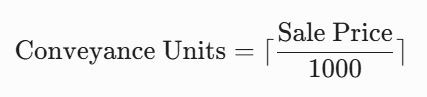
First, the system determines the absolute conveyance units by rounding the gross sale price up to the next $1,000 block.
Conveyance Units = Sale Price divided by1000
Second, the base fee per parcel is derived by multiplying the rounded conveyance units by the combined county rate of $4.00.
Fee Per Parcel = Conveyance Units x $4.00
Finally, the total transaction fee is calculated by applying the multi parcel indexing multiplier.
Total Conveyance Fe = Fee Per Parcel x Parcel Count
Step by Step Guide: How to Use the Stark County Conveyance Fee Calculator
Our digital interface is designed to maximize data compliance while prioritizing rapid execution for professionals working on-site or in the office.
Step 1. Input the Exact Total Sale Price
Enter the final, contractually agreed-upon gross purchase price of the real estate. Do not subtract down payments, mortgage loan balances, or earnest money deposits, as the conveyance tax is levied directly against the raw contract consideration.
Step 2. Set the Total Parcel Count
Specify the exact number of distinct parcel identification numbers being transferred under the current deed document. For a standard single family home, this number is typically one, but it can increase significantly if adjacent structural lots or acreage splits are packaged together.
Step 3. Execute the Calculation Utility
Click the "Compute" command button. The database logic will instantly apply the ceiling function to the sale price, calculate the combined $4.00 per thousand rate, factor in the parcel count, and display the final, unalterable cost in the output field.
Who Benefits Most from This Automated Tool?
- Homebuyers and Property Sellers: Empowers private consumers to verify their settlement statements beforehand, ensuring they are not overpaying or facing unexpected out-of-pocket expenses at the closing table.
- Licensed Real Estate Agents: Allows agents to quickly provide accurate net-sheet calculations to sellers or estimate closing costs for buyers during live contract negotiations.
- Title and Escrow Professionals: Streamlines workflow automation by offering a fast, reliable desktop resource to cross check complex property file transfers.
- Real Estate Investors and Developers: Facilitates rapid deal analysis for distressed real estate portfolios or wholesale multi-parcel tracts where transaction speed is vital to securing equity.
Conclusion
Understanding real estate transfer fees is an essential component of professional property management and investment in Ohio. The Stark County Conveyance Fee Calculator eliminates manual guesswork, integrates exact legislative rules, and provides a clear pathway to flawless real estate recording. By following this guide step-by-step, you can navigate your next real estate closing with total financial confidence and complete compliance.
FAQs
Who is legally responsible for paying the conveyance fee in Stark County?
By local custom and standard real estate practice in Ohio, the seller is typically responsible for paying the conveyance fee at closing. However, this obligation can be contractually negotiated between the buyer and seller prior to signing the final purchase agreement.
Are any property transfers exempt from the Stark County conveyance fee?
Yes, certain transactions are legally exempt from conveyance fees under Ohio law. Common exemptions include property transfers between spouses, deed changes resulting from a direct inheritance or a will, property gifts to government entities, and corporate reorganizations where no cash consideration is exchanged. Exempt transactions still require a statement of value form to be filed with the Auditor.
What is the difference between a conveyance fee and a recording fee?
The conveyance fee is an asset transfer tax calculated based on the sale price and parcel count of the property. The recording fee is a separate flat service charge collected by the County Recorder's office to physically log and archive the new deed document within the public archives.
Why does the parcel count affect the total conveyance fee cost?
The Stark County Auditor assesses the operational costs of updating and indexing public records on a per-parcel basis. When multiple parcels are processed, the system multiplies the statutory unit fee by the number of individual parcel records being modified to account for the additional administrative tracking required.