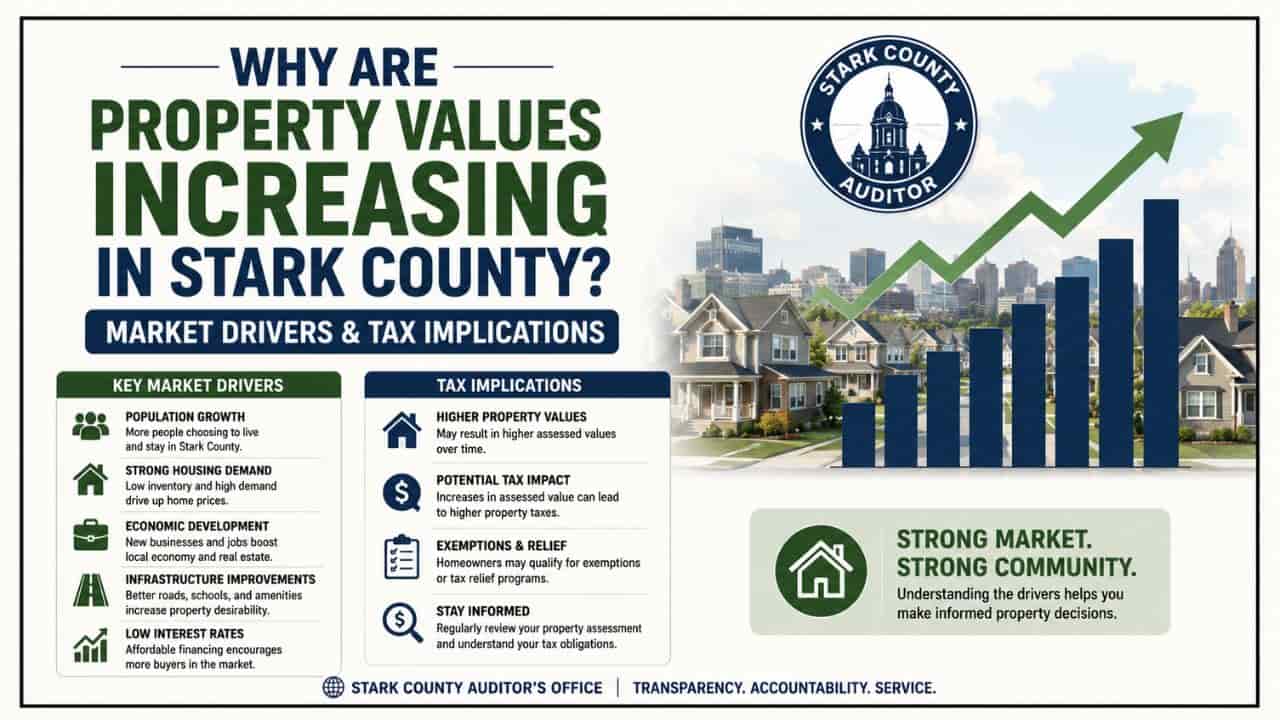
For Stark County property owners and prospective buyers, the recent upward trajectory of local real estate valuations has sparked both financial opportunities and administrative questions. Over the past few years, neighborhoods stretching from Canton and Massillon to North Canton and Plain Township have witnessed unprecedented equity growth. While this surge strengthens household wealth for existing homeowners, it simultaneously reshapes the local tax landscape and impacts neighborhood affordability. Understanding this shifting market requires a clear, data-driven understanding of macroeconomic factors, local inventory constraints, and the official administrative processes that track these changes.
Economic Drivers Fueling the Stark County Real Estate Surge
The appreciation of residential and commercial properties across the region is not an isolated phenomenon; it is the direct result of intersecting economic forces. Understanding these core pillars helps property owners track why their equity continues to rise.
Historic Lows in Housing Inventory
The primary catalyst for increasing values is a structural imbalance between supply and demand. For multiple consecutive quarters, the inventory of available single-family homes in the region has remained well below historical norms. When fewer homes are listed for sale, buyers must compete for the limited options on the market. This competitive environment naturally drives up final sale prices, establishing higher baseline valuations across entire neighborhoods.
The Affordability Shift from Major Ohio Metropolitan Hubs
As housing costs skyrocket in major metropolitan areas like Columbus, Cleveland, and Akron, mid-sized regional markets have become highly attractive alternatives. Remote work flexibilities and corporate relocations have allowed professionals to seek out communities that offer a lower cost of living without sacrificing civic amenities.
- Cost-to-Value Ratio: Buyers from larger cities find they can secure more square footage and larger lot sizes in Stark County for a fraction of the cost.
- Commuter Appeal: Proximity to Interstate 77 and U.S. Route 30 makes the region an ideal base for regional commuters.
- Stabilized Local Demand: This influx of out-of-city buyers sustains a steady floor of demand, keeping upward pressure on local home prices.
Local Infrastructure and Economic Development
Targeted investments in regional infrastructure, localized commercial districts, and community medical hubs have significantly enhanced neighborhood desirability. Areas with highly rated public school districts, updated parks, and accessible retail centers see the fastest rates of appreciation because they directly align with modern family preferences.
The Stark County Auditor’s Role in Tracking Property Values
When real estate markets experience rapid price fluctuations, the administrative framework of local government must document these shifts to maintain equitable operations. This tracking is where the county administration plays an essential operational role.
The Mechanism of Mass Appraisal
The local administrative desk does not establish market prices; instead, it tracks actual, real-world real estate transactions to calculate fair market values for tax purposes. By analyzing valid, arm’s-length sales where a willing buyer and seller agree on a price, analysts map out broader neighborhood trends. This ensures that assessed values lag behind or mirror true market conditions fairly, rather than reacting to temporary speculative spikes.
Mandated Revaluation Timelines
Per Ohio revised statutes, real estate assessments follow strict cyclical updates to guarantee that public records reflect economic realities.
| Update Cycle Type | Statutory Frequency | Core Administrative Purpose |
| Sexennial Reappraisal | Every 6 Years | Comprehensive view involving physical viewings and full structural audits of every parcel. |
| Triennial Update | Every 3 Years | Mid-point statistical review adjusting values based entirely on recent neighborhood sales data. |
| Annual Equalization | Yearly Oversight | Minor adjustments target specific structural changes, new construction, or localized damage. |
Structural Elements Influencing Individual Parcel Valuations
While macro trends dictate county-wide growth, individual property values rise or fall based on specific structural characteristics. Homeowners looking to understand or verify their specific valuation adjustments should evaluate these distinct components.
1. Neighborhood Location and School District Borders
Properties located within highly requested school districts typically command a premium. Even similar architectural layouts built by the same developer will show different appreciation tracks if they sit on opposite sides of a municipal or district boundary line.
2. Total Finished Square Footage and Usable Space
The overall size of the primary structure remains a heavy weight in automated valuation models.
- Finished Basements: Converting lower-level space into compliant living areas boosts total utility.
- Additions: Constructing attached garages, sunrooms, or extra bedrooms shifts the structural baseline upward.
- Functional Layout: Modernized floor plans with open concepts frequently score higher in consumer demand indexes.
3. Historical Comparable Sales (Comps)
The final variable is the recent transactional history of neighboring properties. When a matching property down the street sells for a record high, that transaction serves as a benchmark data point for the immediate geographic radius, lifting the mathematical averages of surrounding parcels.
Actionable Steps for Property Owners Facing Rising Values
Value growth builds excellent financial equity, but it also alters annual holding costs. Local property owners must take a proactive approach to managing their real estate assets during an inflationary cycle.
Step 1: Routinely Review Public Property Records
Errors in public property databases can lead to inaccurate valuation spikes. Property owners should verify that their official parcel cards accurately list structural details. Check to ensure that square footage calculations, bedroom counts, and structural grade ratings perfectly match the physical reality of the home.
Step 2: Understand the Link Between Value and Taxation
It is a common misconception that a 20% increase in property value automatically triggers a 20% increase in property taxes. Due to Ohio’s House Bill 920, tax reduction factors prevent local agencies from collecting inflationary windfalls on voted millage. Taxes generally only rise significantly if a property’s value grows at a faster rate than the county-wide average, or if local voters pass new operational levies.
Step 3: Utilize Official Public Channels for Grievances
If a homeowner believes their official real estate valuation exceeds its actual, revisable cash market value, the legislative system provides a formal path for recourse.
Property owners can file a formal complaint via Form 101 with the local Board of Revision (BOR) between January 1st and March 31st annually. During these sessions, owners present objective evidence such as independent appraisals, certified closing statements, or structural repair estimates to request a formal correction to their property index record.
Conclusion
Sustained equity growth across Stark County reflects a structural supply deficiency paired with shifting regional demographic demands. For local property owners, tracking these shifting baseline market valuations is essential for active wealth preservation. While structural changes and recent neighborhood comparable sales continue to elevate local indicators, utilizing official municipal tracking resources ensures your real estate portfolio adapts fluidly to statutory triennial reassessments and property tax updates.
FAQ
Why are property values increasing so rapidly in Stark County?
A severe shortage of housing inventory combined with out-of-city buyers seeking affordability continues to drive up residential real estate prices across major local school districts.
How often does the Stark County Auditor update property values?
Ohio law mandates a comprehensive physical sexennial reappraisal every six years, supplemented by a mid-point statistical triennial update based entirely on recent neighborhood sales data trends.
Will a property value increase automatically raise my taxes?
No. Due to Ohio House Bill 920, tax reduction factors prevent automatic inflationary windfalls on voted millage, stabilizing rates unless structural changes or new local levies occur.
What factors impact my individual parcel valuation the most?
Specific property valuations are heavily weighted by finished square footage, structural age, neighborhood location rating, and certified historical comparable sales within your immediate geographic radius.
How can I appeal an unfair real estate market valuation?
Property owners can file a formal complaint via Form 101 with the local Board of Revision between January 1st and March 31st using recent independent appraisals.