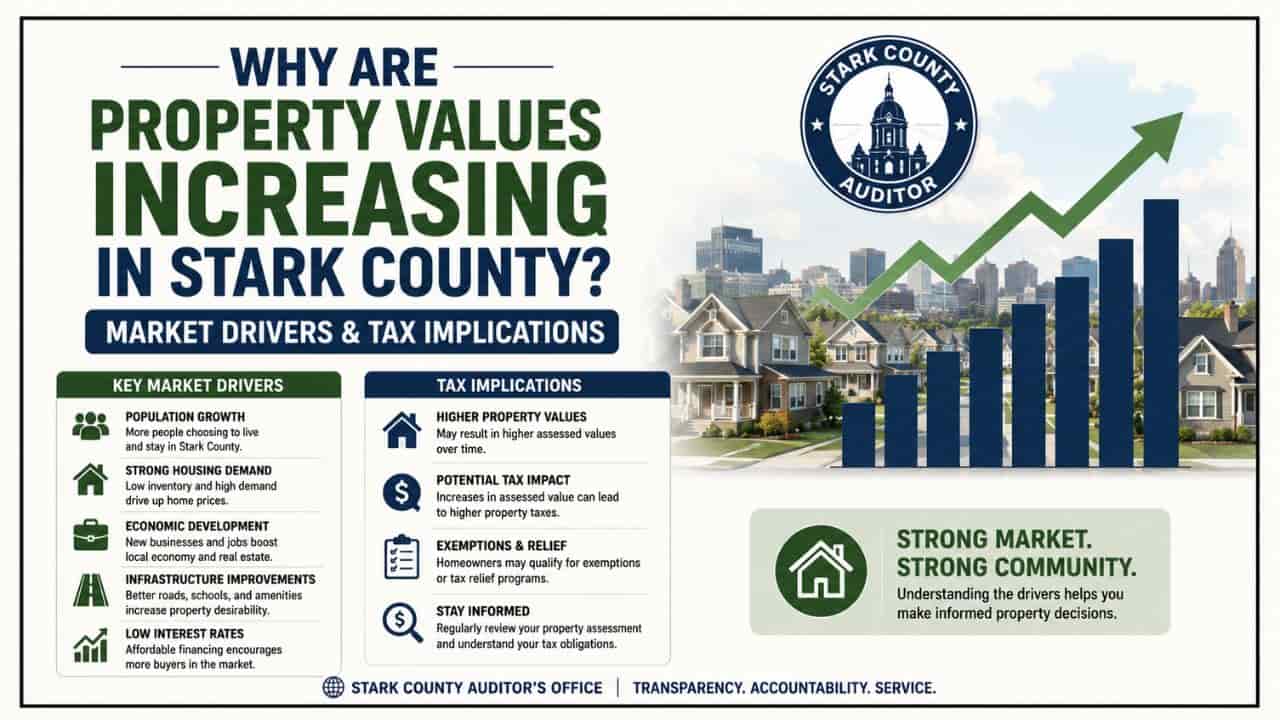
Economic development initiatives across Northeast Ohio serve as powerful catalysts for shifts in structural real estate valuations and regional investment stability. When commercial enterprises and real estate developers leverage strategic tax incentives, they directly reshape the local tax base while driving long-term appreciation across residential and commercial sectors. Understanding this complex regulatory environment requires balancing municipal growth incentives with strict statutory property tax compliance metrics. This comprehensive guide provides an expert-level breakdown of institutional development frameworks, local abatement programs, and the critical regulatory mechanisms required to optimize your real estate investments throughout Stark County.
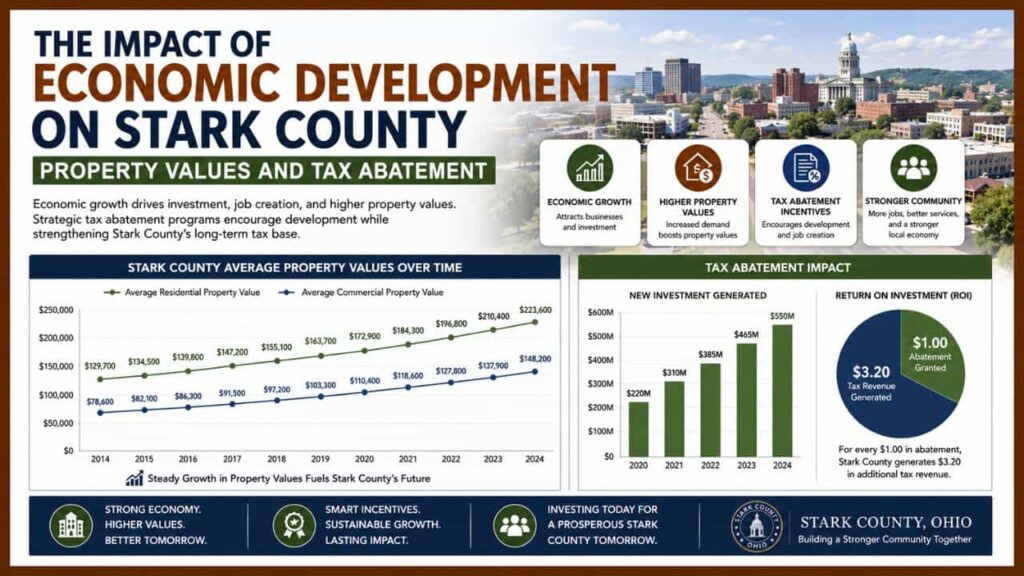
1. Core Drivers of Real Estate Expansion in Stark County
Regional wealth creation and commercial property demand are driven by targeted municipal initiatives. Across Stark County, localized development strategies draw institutional capital, improve local infrastructure, and directly impact the market values of surrounding parcels.
The Role of Localized Growth Boards
Municipal growth depends heavily on active coordination between public administrators and private investors. Entities such as Canton Economic Development and Massillon Economic Development design highly localized programs to attract manufacturing, logistics, and corporate enterprises to their respective urban centers. By providing site-selection support, infrastructure grants, and customized zoning pathways, these localized programs turn vacant industrial zones into high-yield commercial centers. Consequently, as corporate employment grows within these zones, nearby residential subdivisions experience an increase in secondary demand, which steadily raises residential property values.
Institutional Regional Coordination
Beyond city-specific efforts, large-scale economic planning is managed by specialized county organizations. The Stark Economic Development Board operates as a centralized network connecting expanding companies with state-level grants and regional capital resources. Working alongside the Stark County Regional Planning Authority, these entities ensure that commercial real estate projects align with long-term infrastructure improvements, utility expansions, and transit highway planning. This organized approach to regional expansion prevents chaotic, uncoordinated growth, giving real estate investors the predictability they need to forecast long-term property values safely.
2. Understanding Tax Abatement: EZ and CRA Frameworks
Real estate tax incentives in Ohio are structured around two core statutory programs: Enterprise Zones (EZ) and Community Reinvestment Areas (CRA). Both programs incentivize investment by temporarily reducing real property tax burdens, but they apply to different types of real estate and follow distinct administrative pathways.
Enterprise Zones (EZ)
- Focused on **commercial and industrial** expansion.
- Governed by strict statutory **jobs creation metrics**.
- Monitored closely by the **County EZ Manager**.
Community Reinvestment Areas (CRA)
- Open to structural **residential, retail & commercial** assets.
- Targeted directly at local geographic **revitalization plans**.
- Townships must be established by **County Commissioners**.
Enterprise Zone (EZ) Mechanics
The Enterprise Zone program allows the abatement of real property taxes when a company commits to investing in new or expanded facilities, while also agreeing to retain or create new jobs. In Stark County, five specific “county” enterprise zones are closely monitored by the designated County Enterprise Zone Manager. Conversely, the cities of Canton, Massillon, Louisville, and Alliance directly manage their own autonomous enterprise zone programs. Every EZ agreement must strictly adhere to state laws and the operational rules established by the Ohio Department of Development.
Community Reinvestment Area (CRA) Core Attributes
While an enterprise zone focuses heavily on commercial and industrial job creators, a Community Reinvestment Area (CRA) features broader eligibility parameters. Municipalities have the legal authority to create their own unique CRA programs to revitalize local business districts. However, any CRA located within a rural or suburban township must be officially established by the Stark County Commissioners. A key distinction of the CRA framework is its flexibility: retail operations and residential housing developments are only eligible for property tax abatements if they are built within a legally designated community reinvestment area.
3. Comparative Matrix: Local Economic Incentive Zones
To maximize your real estate development strategy, you must evaluate how different incentive programs align with your specific asset class and long-term investment horizon.
| Regulatory Parameter | Enterprise Zone (EZ) Program | Community Reinvestment Area (CRA) |
| Primary Asset Eligibility | Commercial and heavy industrial facilities. | Residential housing, retail spaces, and commercial properties. |
| Administrative Oversight | Managed by the County EZ Manager or specific cities. | Administered by local municipalities or County Commissioners. |
| Core Compliance Metric | Strict statutory job creation and retention quotas. | Geographic capital investment and property structural updates. |
| Statutory Reporting Deadline | Annual business reports filed by the end of March. | Mandatory continuous review by local review councils. |
| Township Approval Path | Negotiated directly through County Commissioners. | Must be formally designated by Stark County Commissioners. |
4. The Administrative Role of the Stark County Auditor
While economic planning groups design growth incentives, the Stark County Auditor serves as the vital legal authority responsible for managing, calculating, and applying these adjustments to the official county ledger.
[Incentive Approved by City/County] ---> [Auditor Updates Tax Ledger] ---> [Abated Value Applied Safely]
Valuation Controls and Tax Ledger Maintenance
Once a tax abatement agreement is legally signed by a city or the County Commissioners, it is forwarded to the Stark County Auditor. The Auditor’s office carefully tracks the property’s baseline assessment and ensures that any new construction or expansion values are accurately separated on the tax ledger. For the duration of the approved abatement term, the Auditor zeros out or reduces the taxable rate on the qualifying improved value, keeping the property profile accurate and legally compliant with Ohio revised codes.
Reappraisal Integrity and Post-Abatement Transitions
The Stark County Auditor evaluates all local real estate on a strict, state-mandated six-year reappraisal cycle, supplemented by a triennial statistical update. When an abated property undergoes valuation updates, the Auditor ensures that the structural market value is adjusted fairly without prematurely canceling the active tax exemption. Once the abatement period expires, the Auditor seamlessly restores the full assessed value to the active tax rolls, preventing sudden budgeting shocks for local school boards and public services.
5. Compliance and Annual Review Protocols
Securing a property tax abatement is not a one-time event; it requires continuous compliance with strict monitoring laws to prevent the retroactive cancellation of your tax benefits.
- Mandatory TIRC Evaluation: A Tax Incentive Review Council (TIRC) comprising county officials, local government leaders, and school board representatives is legally required to meet at least once a year to audit active abatements.
- Annual Business Reporting: Companies receiving an abatement must file detailed operational reports by the end of March each year, demonstrating that they have met their capital investment and employment targets.
- State Agency Audits: All local TIRC compliance findings and regional tax abatement reports are compiled and filed annually with the Ohio Department of Development to ensure full state-wide transparency.
- Local Government Consultation: Before initiating any physical construction or expansion, businesses must first contact the specific township, village, or city where the project is located to confirm boundary compliance. To visually verify active EZ or CRA boundaries, developers can consult the interactive spatial maps hosted on the Stark County Regional Planning Commission (RPC) ArcGIS portal.
Conclusion
The connection between economic development programs and property values shapes the future of investment across Stark County. By leveraging Enterprise Zones and Community Reinvestment Areas, property owners can significantly lower their initial operational overhead while directly increasing the long-term equity of their holdings. Managing these benefits requires careful compliance, consistent tracking of deadlines, and open communication with the Stark County Auditor. Using these public incentives responsibly ensures your real estate investments remain highly profitable, legally secure, and positioned for sustainable growth within the Ohio market.
FAQs
What is the role of the Stark County Auditor in tax abatement?
The Stark County Auditor manages the local tax ledger, separates abated values from baseline assessments, and updates records during the state-mandated six-year reappraisal cycle.
How does economic development and tax abatement impact property values?
Strategic economic development and tax abatement attract institutional commercial capital, which improves regional utility infrastructure and steadily drives up residential real estate valuations in surrounding subdivisions.
Which properties qualify for Canton Economic Development CRA incentives?
The Canton Economic Development CRA framework permits property tax abatements for commercial infrastructure, retail spaces, and structural residential updates built inside legally designated revitalization boundaries.
What are the compliance rules for Massillon Economic Development enterprise zones?
Companies in Massillon Economic Development enterprise zones must meet strict statutory job creation quotas and submit annual operational reports to the review council by March.
How do the Stark Economic Development Board and SCRPC verify boundaries?
The Stark Economic Development Board partners with the Stark County Regional Planning Authority (SCRPC) to map official EZ and CRA investment boundaries using interactive ArcGIS portals.