Starting a business in Canton, Massillon, Alliance, or any of the surrounding townships within Stark County requires a clear understanding of local regulatory compliance. In Ohio, the Stark County Auditor serves as the primary regional administrative agent for business registration, ensuring that entities are properly structured to collect and remit sales tax. For entrepreneurs preparing a technical rollout, this comprehensive, step by step guide addresses the precise operational requirements for acquiring official vendor licenses, navigating municipal oversight, and maintaining regulatory compliance without facing legal bottlenecks or tax penalties.
The Strategic Role of the Stark County Auditor in Business Licensing
While corporate entity formations (such as LLCs or Corporations) are managed exclusively at the state level via the Ohio Secretary of State, operational retail compliance is administered locally. The Stark County Auditor handles registration for business activities involving taxable retail transactions, ensures fair market trade through specialized equipment calibrations, and tracks specific regional excise revenue.
| Ohio Secretary of State | –> | Stark County Auditor Office |
| (LLC / Corp Formation) | | (Local License & Compliance) |
Failing to register with the Auditor before opening your doors to consumers can result in immediate tax assessments, failure-to-file penalties, and potential “Red Tagging” of your business equipment by county enforcement divisions.
Core Operational Benefits of a Vendor’s License
An official Ohio Vendor’s License does not merely serve as a regulatory permit; it acts as a structural asset for your corporate tax ecosystem. Legally, any entity engaging in the sale of tangible personal property or providing specific taxable services within Ohio boundaries must register.
A designated account number tied to your vendor asset allows you to:
- Execute Lawful Sales Tax Collection:
Legally collect state and local piggyback sales taxes at the physical point of sale. - Leverage Ohio Resale Certificates:
Purchase raw inventory or wholesale items completely tax-free by providing a valid exemption certificate to suppliers. - Establish Enterprise Credibility:
Secure business banking infrastructure, lines of credit, and merchant merchant accounts requiring physical proof of local administrative registration.
2026 Stark County Vendor License Framework
The Ohio Department of Taxation, alongside county auditors, maintains distinct categories for retail operations. Choosing the incorrect license framework will distort your sales tax return data and create compliance issues during audits.
The table below breaks down the updated classification matrix, statutory fee structure, and baseline operational mandates.
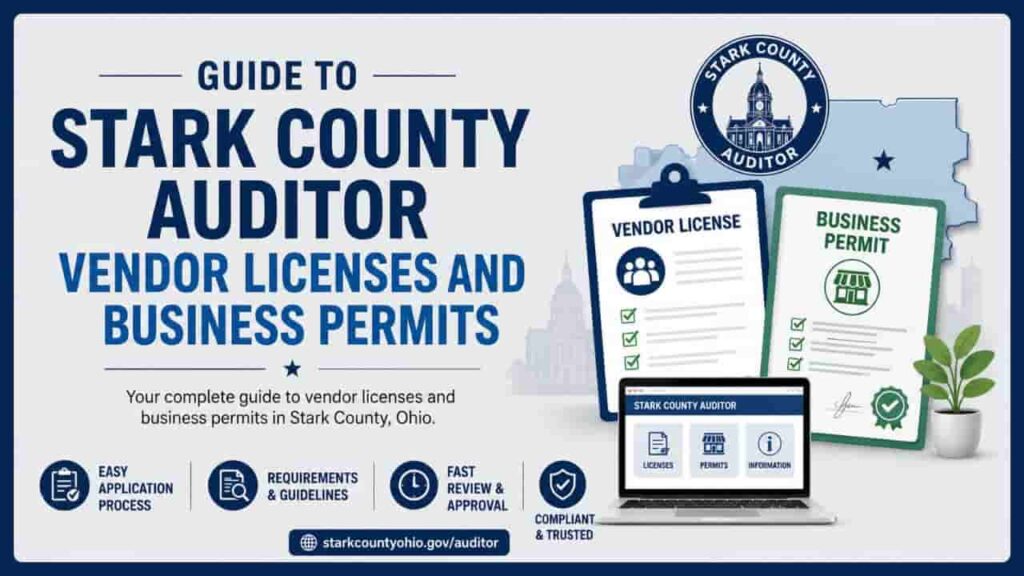
| License Type | Ideal For | Official Fee |
| County Vendor’s License | Fixed retail storefronts, brick-and-mortar operations, or permanent commercial spaces situated inside Stark County boundaries. | $50.00 (One-time application fee per location) |
| Transient Vendor’s License | Mobile retail setups, traveling exhibitors, pop-up boutiques, or flea market operators moving across multiple Ohio counties. | $50.00 (One-time registration fee managed via the State) |
| Cigarette License | Any physical retail footprint or wholesale distributor selling tobacco products within Stark County. | $125.00 (Mandatory annual renewal fee) |
2026 Statutory Update: Effective recently via legislative changes, the baseline application fee for regular County and Transient Vendor’s Licenses throughout Ohio is $50.00 (increased from the historical $25.00 flat rate). Additionally, under current tax laws, the vendor timely-filing discount (0.75%) is capped at $750 per license for each month covered by the sales tax return.
Step by Step Guide: How to Apply for Your License
To ensure your application is processed efficiently by the Auditor’s office, follow this sequential setup routine.
1. Establish and Register Your Legal Business Structure: Prerequisite Phase.
Before approaching the county, you must formalize your corporate entity structure. If operating as an LLC, Partnership, or Corporation, file your Articles of Organization with the Ohio Secretary of State. You must secure a Federal Employer Identification Number (EIN) via the IRS and ensure your corporate filing matches your physical Stark County address.
2. Complete and Transmit Form ST-1: Application Phase.
The application for a standard retail location requires filing an official Form ST-1. You have two primary pathways to complete this:
- Online Processing (Recommended): Submit electronically through the unified Ohio Business Gateway (OBG) portal. This is the fastest processing pipeline.
- In-Person Filing: Visit the Stark County Auditor’s physical office at 110 Central Plaza South, Suite 220, Canton, OH 44702.
3. Remit the Non-Refundable Statutory Fees: Payment Phase.
Pay the flat $50.00 application fee. When using the online OBG portal, payment can be processed via electronic check or approved credit cards. For in-person submissions at the Canton office, payments can be made via cash, business check, or credit card (subject to localized processor convenience fees).
4. Display the Document at Your Physical Point of Sale: Post-Issuance Compliance.
Once approved, the state or county will provide a physical license certificate. Ohio law mandates that this document be prominently displayed at your principal place of business. If you hold a Transient License, you must maintain a physical or clear digital copy on-site during all trade shows, fairs, or pop-up events.
Regulated Commercial Equipment: Weights and Measures Compliance
If your business infrastructure utilizes automated scales, commercial scanners, or precise liquid fuel pumps to determine price parameters based on weight or volume (such as gas stations, delis, grocery stores, or scrap yards), you fall under the strict oversight of the Stark County Weights and Measures Division.
The Annual Inspection Mandate
County inspectors conduct unannounced field tests annually on all commercial weighing and measuring devices. This ensures that a pound of product or a gallon of fuel delivered to a consumer measures exactly as advertised.
Auditor Validation Seals
- Approved Status: Devices passing mechanical tolerance testing receive an official, dated Stark County Auditor validation seal applied directly to the machine face.
- The “Red Tag” Sanction: Equipment failing accuracy checks is immediately issued a restrictive Red Tag. A red-tagged device is legally removed from service and cannot be used for commercial trade until repaired by a certified technician and re-inspected by the county.
Troubleshooting Common Licensing Pitfalls
Shifting Address or Commercial Relocation
A regular County Vendor’s License is structurally tied to a single, unique physical address. If you move your boutique or storefront from Massillon to North Canton, your existing license is legally void at the new location. You must log into the Ohio Department of Taxation portal, update your corporate address details, cancel the old location’s license, and purchase a fresh $50.00 license for the new address.
Winding Down Operations
If you close your doors, dissolve your LLC, or sell your business assets, you cannot simply abandon your tax accounts. You must file a final sales tax return within 15 days of closure and formally cancel your vendor status. Failure to execute this step prompts automated “estimated tax assessments” from the state, generating artificial tax debts and late penalties even if your actual sales were zero.
Tobacco Sales Transactability
Unlike permanent retail permits, a Cigarette License is not a one-time fee. It requires a mandatory $125.00 renewal every May. If you acquire an ongoing convenience store or gas station that already sells tobacco, the existing license does not transfer to your new entity. You must file a fresh application under your own EIN immediately upon closing the acquisition.
Conclusion
Successfully executing local retail compliance in Canton, Massillon, and Alliance requires a direct understanding of municipal regulatory layers. While corporate entities originate at the state level, the Stark County Auditor functions as the critical regional checkpoint for processing Form ST-1 applications, monitoring consumer transaction equity via Weights and Measures calibrations, and issuing annual tobacco permits. By mastering these statutory pipelines, entrepreneurs protect their operations from costly tax penalties and build highly sustainable businesses.
FAQs
How do I get an official Stark County Vendor’s License?
Apply online via the Ohio Business Gateway by completing Form ST-1. Alternatively, you can file in person at the Stark County Auditor’s Office located in downtown Canton.
What is the difference between an Ohio County and Transient License?
A County Vendor’s License binds your retail tax collections to one permanent Stark County storefront. A Transient Vendor’s License permits mobile retail operations across multiple Ohio counties.
Does an Ohio retail business permit expire annually?
No. A standard Stark County Vendor’s License is permanent and never expires, provided your retail business maintains the identical legal ownership structure and physical address.
How much does a Stark County business vendor permit cost?
Per modern statutory updates, both regular County and Transient Vendor Licenses require a one-time, non-refundable $50.00 application fee payable through the state or local Auditor.
What happens if my retail business equipment fails local inspection?
The Stark County Weights and Measures Division will issue a restrictive Red Tag, legally removing the inaccurate commercial scale or pump from service until certified repairs are completed.