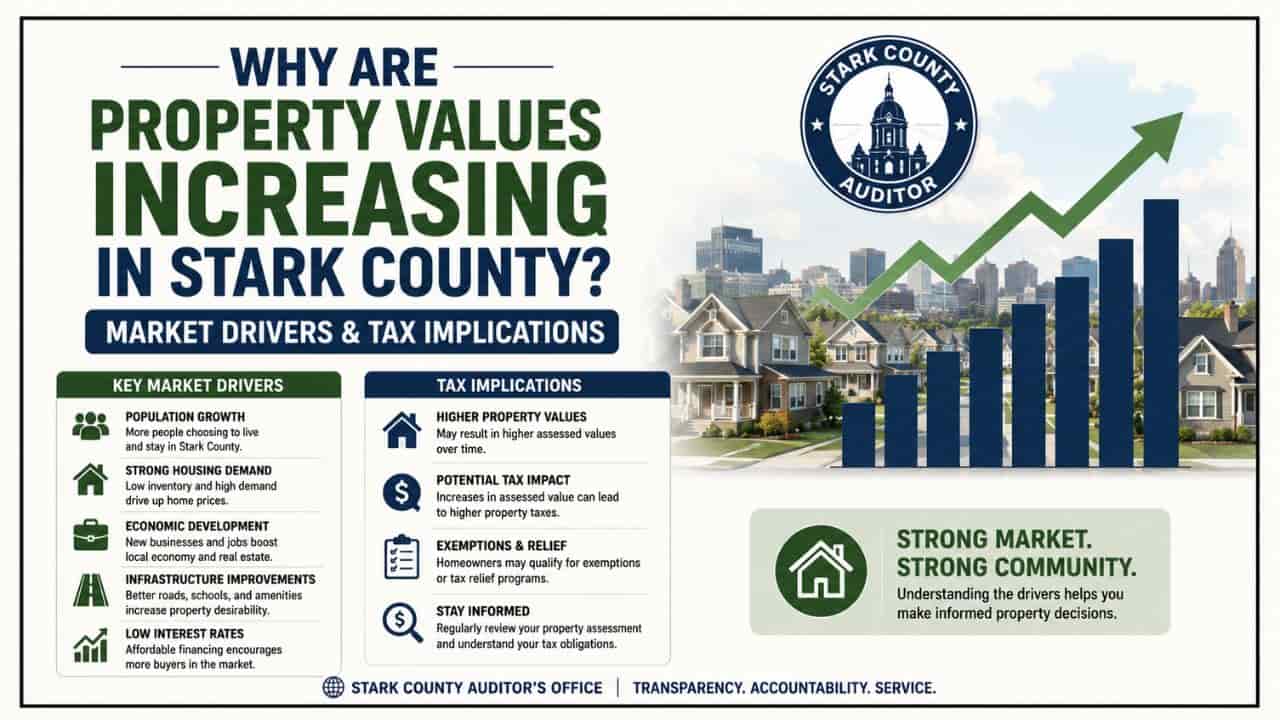
For manufactured and mobile home owners looking to maximize property equity within Canton, Massillon, Alliance, and the surrounding Ohio townships, managing annual structural tax liabilities is a critical fiscal priority. Unlike site-built real estate, manufactured housing assets run under distinct statutory provisions of the Ohio Revised Code (ORC). The Stark County Auditor is the designated chief assessment officer and data custodian responsible for classifying housing stock, maintaining the permanent county registry, and calculating the localized Manufactured Home Tax (historically tracked as the “Trailer Tax”) to ensure transparent municipal funding structures across Northeast Ohio.

The Role of the Stark County Auditor
In Ohio public record informatics, the County Auditor performs several overlapping legal and regulatory functions concerning manufactured structures. Understanding the Auditor’s exact corporate role helps owners interface with the local justice and tax infrastructure efficiently:
- Ultimate Data Custodian & Validator:
The Auditor maintains the official, permanent master index of all manufactured housing units situated inside county limits, tracking changes in vehicle identification numbers (VINs), structural additions, and current physical coordinates. - Mass Appraisal & Valuation Mapping:
Under ORC guidelines, the Auditor’s appraisal division calculates the fair market value or statutory depreciation baseline for every unit, compiling these figures into the county’s interactive Computer-Assisted Mass Appraisal (CAMA) data streams. - Tax Rate Computation:
The Auditor applies localized voter-approved millage levies and state-mandated House Bill 920 reduction factors to compute the gross and net annual tax duplicate before passing the finalized collection data over to the Stark County Treasurer. - Relocation Regulatory Control:
The Auditor serves as the single enforcement authority responsible for issuing transit documentation and enforcing statutory penalties against illegal unpermitted unit movements.
Technical Classifications of Manufactured Home Taxation
A manufactured unit’s structural tax structure depends entirely on its legal classification. In Stark County, the system utilizes two distinct methods managed by the Auditor:
1. The Depreciated Valuation System (The Historical Framework)
Units purchased or placed on site prior to January 1, 2000, are generally evaluated using a standard state-mandated depreciation schedule. Under this metric, the home is classified legally as personal property rather than real estate. The taxable baseline reduces continuously over time based on the initial purchase price index.
2. The Appraised Market Value Method (The Modern Framework)
Any home purchased, transferred, or relocated after January 1, 2000, automatically shifts into the modern appraisal system. The Stark County Auditor appraises these assets using real property principles, establishing a fair market value baseline that matches local structural sales trends and neighborhood index updates.
Critical Deadlines and Operational Timeline
To protect your real estate portfolio from automatic late-payment penalties, owners must monitor the official collection timeline closely. While the Auditor calculates the underlying values, the Stark County Treasurer executes collection:
| Statutory Event / Deadline | Specific Calendar Window | Administrative Purpose & Impact |
| First-Half Tax Collection | March 1st | Settlement deadline for the initial semi-annual manufactured tax installment. |
| Second-Half Tax Collection | July 31st | Final deadline to clear outstanding annual manufactured tax balances without penalty. |
| Board of Revision Filing | January 1st – March 31st | Official window to submit valuation challenges via a formal assessment dispute. |
Step by Step Sequence: Ownership Transfers and Moving Permits
To legally sell, buy, or execute a physical structural relocation of a manufactured home within Stark County boundaries, you must complete this specific administrative sequence to clear titles and avoid heavy municipal fines:
1. Secure an Official Tax Release Certificate: Clear All Prior Balances in Canton.
Visit the Stark County Treasurer’s Office located at 110 Central Plaza South, Canton, OH. Settle all current and delinquent tax assessments for the full calendar year. The Treasurer will issue a stamped, certified Tax Release Certificate confirming a clean tax ledger.
2. Pay County Real Estate Conveyance Fees: Process Conveyance through the Auditor.
Take your stamped Tax Release and the original title to the Stark County Auditor’s Transfer Department. The Auditor will collect the local conveyance fee ($4.00 per thousand based on the sales price) plus a $0.50 transfer fee, stamping the title “Transfer Approved.”
3. Execute Title Assignment at the Clerk of Courts: Update Title Records.
Present your approved, stamped documentation to the Stark County Clerk of Courts Title Division. The Clerk will legally inactivate the old record and issue a fresh, unencumbered Manufactured Home Title in the new buyer’s name.
4. Obtain a Mandatory $5.00 Moving Permit: Secure Transit Approvals.
If the unit is shifting locations on public roads, apply for a formal Moving Permit at the Auditor’s office. Moving a manufactured unit without this $5.00 authorization triggers an immediate $100.00 penalty for both the property owner and the towing company.
Strategic Tax Relief and Assessment Credits
Stark County manufactured homeowners are fully entitled to localized tax mitigation frameworks designed to shield property values:
The 2.5% Owner-Occupancy Reduction: If you reside in the manufactured unit as your permanent, primary residence, you are eligible for the Owner-Occupancy Credit. This applies an immediate 2.5% reduction directly onto your gross billings. Ensure your primary residency status is filed with the Auditor within 30 days of move-in.
The Senior & Disabled Homestead Exemption
Homeowners aged 65 or older, or individuals who are permanently and totally disabled, can apply through the Auditor’s office to lock in the Homestead Exemption. This program effectively shields the first $26,200 of your appraised market value from local taxation, significantly minimizing your annual financial exposure.
Conclusion
Successfully managing Stark County manufactured home taxes requires owners to remain proactive regarding state registrations, moving clearances, and annual transfer certification rules. By working directly with the official infrastructure managed by the Stark County Auditor and Treasurer, mobile home owners can secure fair structural valuations, avoid steep administrative penalties, and maximize local tax exemptions safely and efficiently.
FAQs
How do I register a new mobile home with the Stark County Auditor?
Owners must register their manufactured unit with the Stark County Auditor within 30 days of purchase or installation. Failure to file at the Canton office triggers an automatic $100 penalty.
Where do I get a manufactured home moving permit in Stark County?
Purchase a Moving Permit directly from the Auditor’s office for a $5.00 fee. All underlying localized property taxes must be paid in full to the Treasurer before transit is authorized.
Do manufactured home owners qualify for the Homestead Exemption?
Yes. Low-income seniors aged 65 and older, or permanently disabled residents, can file an application with the Auditor to shield a portion of their unit’s value from annual taxation.
How can I lower an inflated manufactured home tax value?
File a formal valuation complaint with the Stark County Board of Revision (BOR) between January 1 and March 31, providing recent bills of sale or structural damage photos as evidence.
How do I change my mobile home tax address?
Submit an official Address Change Request directly to the Stark County Treasurer’s Office to ensure annual bills arrive at your personal lot rather than the park’s central management office.