For institutional real estate investors, portfolio managers, and regional homeowners in Northeast Ohio, the Stark County Delinquent Tax List is a critical financial resource. When property owners default on their statutory liabilities, unpaid balances trigger public records listing. Resolving these active tax liens under the Ohio Revised Code requires clear communication with the Stark County Treasurer and the Stark County Auditor. This comprehensive guide outlines how to seamlessly search delinquent parcel data online, calculate outstanding interest penalty schedules, and safely protect your valued local real estate investment portfolio equity returns.
Understanding Tax Delinquency: What Does “Delinquency” Mean?
Before tracking the public record databases, it is essential to define what real estate tax delinquency actually implies under Ohio law.
In simple terms, delinquency means a state of being past due on a legal financial obligation. When a Stark County property owner fails to pay their semi-annual real estate taxes, special assessments, or municipal charges by the official deadlines certified by the Treasurer, the parcel automatically transitions from an “active” tax status to a “delinquent” tax status. Under Ohio Revised Code (ORC) frameworks, a tax obligation becomes delinquent the exact moment the clock strikes midnight on the close of the certified collection due date. This administrative tag remains attached to the property card accumulating statutory interest and penalty charges until the outstanding balance is either paid in full or settled through an authorized payment contract.
The Statutory Framework: What is the Delinquent Tax List?
Under ORC Section 5721.03, the County Treasurer must compile a comprehensive list of all real estate parcels that carry an unpaid tax balance after the final settlement of the semi-annual collection cycle. This master roll is not simply an internal spreadsheet; it is an official administrative ledger.
By statutory mandate, the Stark County Delinquent Tax List must be published periodically in a local newspaper of general circulation (such as The Repository) to provide formal public notice of the debt.
The master delinquency database tracks several critical data elements for each listed parcel:
- Registered Title Holder: The legal owner of record as indexed by the Stark County Recorder.
- 7-Digit Parcel Identification Number: The core parcel code assigned by the Stark County Auditor property search infrastructure.
- Certified Principal Delinquency: The base amount of unpaid real estate taxes, excluding ongoing fees.
- Statutory Penalties and Interest: The cumulative 10% upfront late fee plus state-indexed interest charges added under
ORC §323.121.
Tax Default Triggers and Financial Penalties
A property is not placed on the delinquency list overnight. The transition from a standard unpaid bill to an actionable tax lien follows a strict statutory schedule.
| Timeline Stage | Administrative Action Triggered | Financial Impact on Title |
| Immediate Post-Deadline | The Treasurer applies a statutory late-payment penalty to the unpaid balance. | 10% upfront penalty added directly to the principal tax balance. |
| August 1st & December 1st | Statutory interest charges accrue on all past-due balances (ORC §323.121). | Compounded semi-annual interest calculated based on state-indexed interest rates. |
| Annual November Settlement | The Treasurer certifies the list of chronically delinquent parcels to the Stark County Prosecutor. | The property is officially added to the Stark County Delinquent Tax List and hit with publication fees. |
Step by Step Guide: Accessing and Searching Delinquent Parcels
Whether you are an investor looking for discounted assets or a homeowner verifying your account standing, you can extract live data using three main channels.
Step 1: Query the Stark County Auditor Real Estate Portal
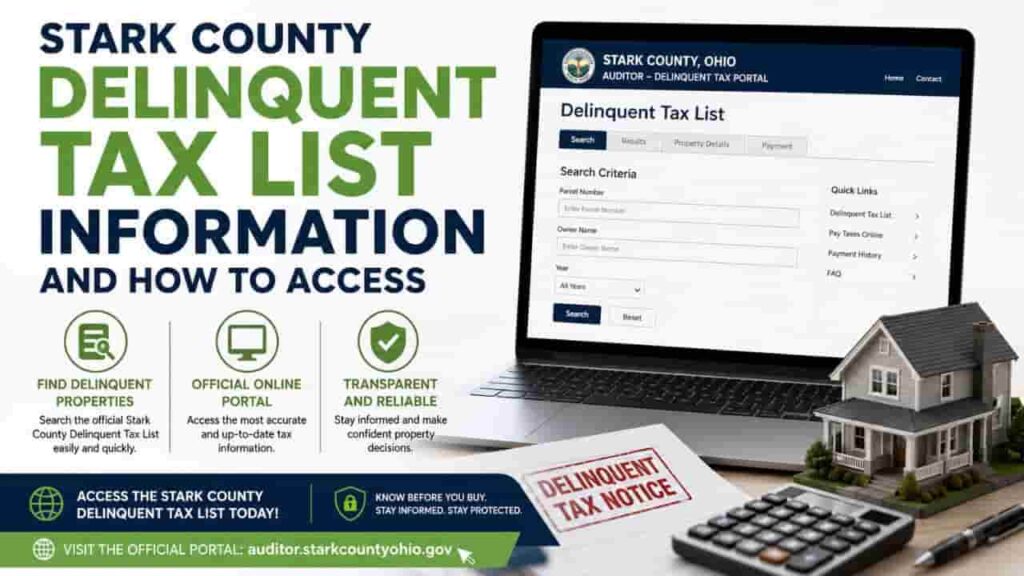
Before downloading bulky county files, perform a specific query on the Stark County Auditor Property Search engine (realestate.starkcountyohio.gov). Search by property address, corporate entity name, or the 7-digit parcel ID. Click on the dedicated Tax Tab to view a line-by-line history of current charges, special assessments, payments, and total outstanding delinquent balances.
Step 2: Download the Master Delinquent Tax List Document
To audit larger sets of properties, go to the Stark County Treasurer’s Portal. During active publication windows, the office provides downloadable electronic copies (typically in PDF format) of the published newspaper delinquency roll.
Go to Treasurer Portal ➔ Select ‘Delinquent Tax Division’ ➔ Download Certified Master List ➔ Filter by Tax District
Step 3: Map Spatial Proximities via the Auditor’s GIS Viewer
For real estate developers tracking vacant lots or abandoned structures on the delinquency list, cross-reference your findings with the Stark County Auditor’s GIS Parcel Viewer. Input the delinquent parcel ID to view its exact boundary layout, zoning codes, and aerial imagery. This step helps verify if a tax-delinquent lot is landlocked or unbuildable before you spend resources pursuing it.
How to Resolve Real Estate Tax Delinquency
If your property is placed on the delinquency list, you must act quickly to halt ongoing interest charges and prevent the county from initiating formal foreclosure proceedings.
Option A: Pay the Certified Balance in Full
The fastest way to clear a tax cloud is to pay the entire outstanding balance—including all penalties, interest, and newspaper publication fees. Payments can be submitted through the Treasurer’s electronic processing system, via mail, or in person at the county building in Canton.
Option B: Execute a Formal Delinquent Tax Payment Contract
If you cannot afford to clear the entire balance at once, you can request a statutory Delinquent Tax Payment Contract under ORC Section 323.31.
Sign Formal Treasurer Contract ➔ Freeze Ongoing Penalty Growth ➔ Submit Scheduled Monthly Installments ➔ Stay Current on New Semi-Annual Tax Bills
Critical Breach Notice: If you fail to make a payment under your installment contract or miss a new semi annual tax deadline, the contract defaults. The Treasurer will immediately reinstate all frozen penalties, and the parcel will be sent to the Prosecutor’s office for foreclosure action.
Analytical Strategy Notes for Real Estate Investors
- Look Out for Tax Certificate Sales:
Stark County occasionally sells tax certificates to private institutional buyers to recover uncollected revenue. When a private investor buys a tax certificate on a parcel, they purchase the county’s first-lien position. If the property owner fails to redeem the certificate by paying off the debt plus high statutory interest rates, the certificate holder can launch a private foreclosure action to take the deed. - Account for Fixed Special Assessments:
When analyzing a property on the delinquency list, always verify if the outstanding balance includes unpaid municipal special assessments (such as delinquent weed cutting, sidewalk repairs, or regional sewer upgrades). These assessments are attached directly to the parcel by the Stark County Auditor and must be paid off alongside the base real estate taxes.
Conclusion
Effectively tracking and accessing the Stark County Delinquent Tax List is a critical part of managing risk and uncovering opportunities within the local real estate market. For homeowners, checking account data through the Stark County Auditor property search portal helps prevent steep 10% penalties and accumulating interest charges. For real estate investors, monitoring these public records allows you to find motivated sellers and source high-yield assets before they hit the auction block. Navigating these county data pipelines carefully protects your real estate investments, clears clouds from titles, and keeps your portfolio financially stable.
FAQs
Does appearing on the Stark County Delinquent Tax List mean my home is in foreclosure?
No. Being placed on the list means your real estate taxes are officially past due and have been certified as delinquent. It serves as a statutory warning. However, if the balance remains unpaid for several consecutive collection cycles, the county will eventually file a tax foreclosure lawsuit.
Can I purchase properties directly from the county delinquent tax list?
You cannot buy properties directly off the list simply by paying the back taxes to the Treasurer. To acquire a tax-delinquent asset, you must either buy the property from the current owner prior to foreclosure, bid on it at a formal public tax foreclosure auction, or apply to acquire it through the Stark County Land Bank if it qualifies as abandoned.
Why is my property listed as delinquent if my mortgage company handles my escrow?
This usually occurs if your mortgage company missed a processing deadline or if a sudden increase in local school levies caused an escrow shortage that went unpaid. Check your transaction history and contact your lender’s tax department immediately.
Can the 10% late payment penalty be waived if I have a valid excuse?
You can file an official Application for the Remission of Real Property Penalties (State Form DTE 23A) with the County Auditor. Penalties can be waived under specific legal guidelines, such as a documented medical emergency, an proven postal service delivery failure, or if it is your first late payment in a five-year window.
How often does the Stark County Treasurer update the online delinquency status?
The online property tax search tools typically update within a few business days after a payment is successfully processed and settled through the county’s banking network.