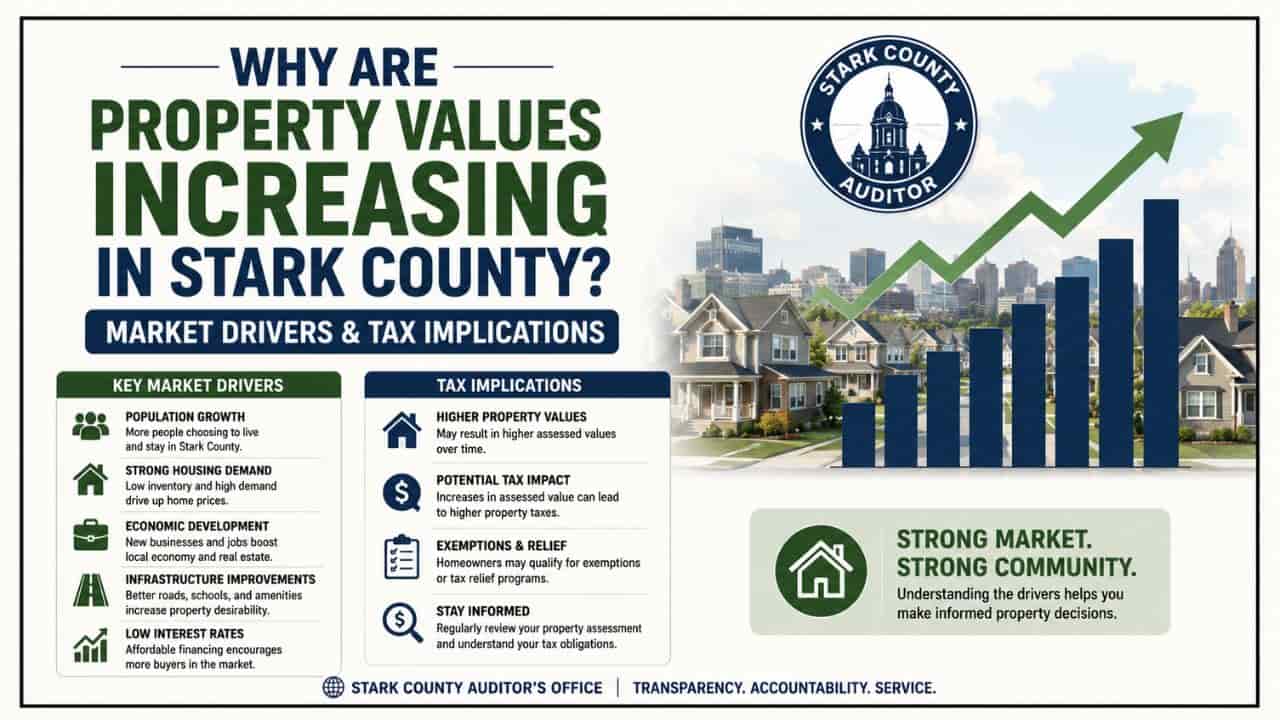
For property owners in Stark County, Ohio, opening a real estate evaluation notice can often lead to immediate confusion. A common issue occurs when a homeowner conducts a property search on the official database and notices two vastly different financial figures attached to their parcel: Appraised Market Value and Assessed Taxable Value.
Failing to understand the critical distinction between these two metrics can lead to costly mistakes, whether you are trying to estimate your annual real estate tax obligations, buying a new home in Canton, or preparing to challenge an unfair property valuation. This comprehensive, expert guide breaks down the official methodologies utilized by the Stark County Auditor’s Office, details the structural mathematical formulas mandated by Ohio state law, and provides a step-by-step roadmap to auditing your property’s valuation data.
The Role of the Stark County Auditor in Determining Value
In the State of Ohio, the County Auditor is legally mandated to oversee the fair and uniform appraisal of every real estate parcel for taxation purposes. It is vital to note that the Stark County Auditor does not establish tax rates or raise taxes. Instead, the Auditor’s sole responsibility is to establish the baseline valuation of the land and any physical structures built upon it.
To ensure that property records reflect actual economic conditions, Ohio law dictates a strict cyclical timeline for mass appraisal updates.
1. The Sexennial Reappraisal
Every six years, the Stark County Auditor executes a comprehensive, county-wide sexennial reappraisal. During this phase, professional appraisers evaluate localized sales trends, review geographic information system (GIS) mapping data, and analyze physical property characteristics to adjust values to current market conditions.
2. The Triennial Update
At the exact three-year midpoint between sexennial reappraisals, the Auditor conducts a statistical triennial update. Rather than performing physical property neighborhood inspections, the Auditor analyzes actual arm’s length real estate sales records across local school districts and townships over the previous three years. Values are adjusted up or down strictly based on these localized market statistics.
Appraised Market Value vs. Assessed Value: The Core Difference
The primary reason property searches trigger confusion is due to the 35% statutory assessment ratio mandated by the Ohio Department of Taxation.
- Appraised Market Value (100%): This is the Auditor’s estimation of what your property would realistically sell for on the open market in an arm’s length transaction between a willing buyer and a willing seller. It accounts for location, square footage, building materials, and comparable sales.
- Assessed Taxable Value (35%): In Ohio, you do not pay property taxes based on 100% of your home’s market value. Instead, your tax liability is calculated using exactly 35% of the appraised market value. This resulting figure is known as the assessed value, or taxable value.
Understanding the Mathematical Relationship
To visualize how these two numbers interact on your public property card, review the structural data breakdown below.
| Valuation Type | Percentage Ratio | Practical Application on Your Tax Bill |
| Appraised Market Value | 100% | Represents the Auditor’s estimated fair market listing price for the land and buildings. |
| Assessed Taxable Value | 35% | The baseline figure that is multiplied by your local millage rate to determine taxes owed. |
| Ohio Statutory Buffer | 65% | The non-taxed portion of your property value protected by state legislative codes. |
Appraised Market Value x 0.35 = Assessed Taxable Value
Step by Step Practical Calculation Example
If the Stark County Auditor establishes the Appraised Market Value of a home in Massillon or Alliance at $200,000, the math to determine the Taxable Value is straightforward.
- Identify the 100% Appraised Market Value: $200,000
- Apply the Ohio statutory assessment ratio: 35%
- Calculate the Assessed Value: $200,000 x 0.35 = $70,000
Your annual property tax bill will be computed using the $70,000 figure, multiplied by the voter-approved millage rates in your individual taxing district.
How to Verify Your Property’s Appraisal Data Online
To ensure you are not being over-taxed due to an error in the county data records, you must periodically audit your property summary sheet. Follow these step by step instruction.
[Stark County Real Estate Search Portal]
├── Search via Address, Owner, or Parcel ID
├── Open the “Value History” or “Appraisal” Screen
└── Audit Structural Specs (Check Year Built, Room Counts, Acreage)
1. Access the Public Records Portal: Go to the official Stark County Real Estate Search interface.
2. Execute a Query: Search for your home using your parcel ID number, site address, or legal owner name.
3. Review the Structural Specs: Click on the “Land” or “Residential” data tabs. Carefully check that the recorded square footage, story height, basement parameters, and garage sizes match your physical home. An error in square footage can artificially inflate your Appraised Market Value.
4. Analyze the Value Summary: Note the current values assigned to the “Land Value” and “Building Value” columns to ensure the math accurately reflects the 35% assessment transformation.
What to Do If Your Appraisal Value Is Too High
If your Auditor-appraised market value exceeds what you could realistically sell your home for in the current local market, you have a legal right to request an adjustment.
Filing a Complaint with the Board of Revision (BOR)
Property owners can formally challenge their property valuation by filing a Complaint Against the Valuation of Real Property (Form DTE 1) with the Stark County Board of Revision (BOR).
- Filing Window: The official filing window opens on January 1st and closes strictly on March 31st of each calendar year.
- The Burden of Proof: To win a valuation appeal, you cannot simply argue that your taxes are too high. You must provide clear evidence that the Auditor’s 100% appraised value is inaccurate.
- Acceptable Evidence: High-quality evidence includes an independent certified home appraisal report, a signed settlement statement (HUD-1) if you bought the property within the last year, or recent certified sales data of identical homes in your immediate neighborhood.
Direct Administrative Resources
For direct inquiries regarding your property’s valuation cycle, tax reduction programs, or to submit physical appeal documentation, contact the county offices downtown:
- Stark County Auditor Office Address: 110 Central Plaza South, Suite 220, Canton, OH 44702
- Stark County Board of Revision Contact: Accessible via the administrative services portal link on the Auditor’s website.
By monitoring your parcel’s appraised market value vs. assessed value, you can guarantee you are paying only your fair, proportional share of local public operational costs.
Conclusion
Understanding the distinction between your Stark County appraised market value and assessed taxable value is crucial for accurate property tax planning in Ohio. By recognizing how the 35% statutory assessment ratio impacts your final bill, you can easily verify county records for data discrepancies. If your public valuation profile doesn’t align with local real estate market realities, filing a timely appeal with the Stark County Board of Revision offers a direct path to tax relief.
FAQs
What is the difference between appraised value and assessed value in Stark County?
Appraised value represents 100% of your home’s estimated fair market worth. Assessed value is exactly 35% of that appraised value, serving as the official taxable baseline.
How often does the Stark County Auditor reappraise properties?
Properties undergo a full physical sexennial reappraisal every six years. At the three-year midpoint, the Auditor applies a statistical triennial update based on local real estate market sales.
Can I lower my Stark County property tax appraisal?
Yes. If the Auditor’s valuation is higher than market value, you can file an official valuation complaint form with the Stark County Board of Revision between January 1 and March 31.
Why did my Stark County property valuation change without an inspection?
This occurs during the mandated triennial update. The Auditor uses local neighborhood real estate sales data statistics to adjust values across entire school districts without physical inspections.
Where do I find my current assessed value online?
Execute a Stark County property search on the official Auditor website using your parcel ID or address, then click on the “Value History” tab to view current metrics.