
Estimating annual real estate liabilities in Ohio requires analyzing state mandated assessment ratios, localized millage rates, and active statutory exemptions. The Stark County Property Tax Calculator simplifies these complex financial computations for homeowners and real estate investors. Whether budgeting for a new home purchase in Canton, evaluating a commercial asset in Massillon, or tracking municipal levies, this institutional grade tool bypasses confusing manual formulas. This definitive guide breaks down the exact operational steps, mathematical frameworks, and legal structures that govern how your property is assessed by the Stark County Auditor.
Tax Calculator
Enter your property details to estimate 2026 property taxes.
Why Using the Stark County Property Tax Calculator is Essential
Property taxes in Ohio are not calculated using a simple flat percentage of your home’s purchase price. Instead, they rely on a sophisticated system of rollback credits, public school district levies, and voter-approved millage rates. Attempting to compute these manually often leads to critical financial miscalculations.
Key Advantages of Utilizing This Digital Tool
- Elimination of Assessment Errors.
The calculator automatically applies the definitive Ohio statutory assessment rate, preventing the common mistake of multiplying tax rates by the full market value. - Proactive Financial Planning.
Enables prospective homebuyers to project true monthly mortgage constants (PITI) by integrating accurate, real-time escrow estimates rather than generic national averages. - Instant Exemption Modeling.
Allows qualified residents to simulate how local credits, such as the Homestead Exemption, dynamically reduce overall out-of-pocket liabilities. - Transparency in Public Funding.
Breaks down exactly how much of your annual bill directly funds localized school boards, emergency services, and county infrastructure projects.
Expert Compliance Note. Real estate tax structures are hyper-localized. Two properties with identical structural floorplans can have vastly different tax bills if they sit on opposite sides of a municipal township line or school district boundary.
| Tax Database Segment | Core Variables Processed | Strategic Analytical Utility |
| Appraised Market Value | Total Land Value, Building Improvements, CAUV Adjustments | Establishes the baseline valuation of the property as determined by the county appraiser. |
| Assessed Taxable Value | 35% Statutory Assessment Ratio (V_a = V_m x 0.35$) | Scales the market value down to the precise legal baseline against which millage is levied. |
| Gross vs Effective Millage | Inside Millage, Outside Levies, HB 920 Reduction Factors | Adjusts the actual tax rate based on voter approved funding limits and inflation protections. |
The Core Mathematical Formula
When you input your data into the calculator, the back end system executes a specific sequence mandated by Ohio Revised Code. First, it isolates your Assessed Value (Va) by scaling your Total Appraised Market Value (Vm) down to thirty five percent:
Va = Vm x 0.35
Next, the tool applies the localized effective millage rate (Me). A single “mill” represents one-thousandth of a dollar, which equates to $1.00 of tax for every $1,000 of assessed value.
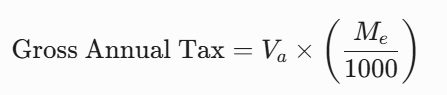
Finally, the system factors in state authorized non-business rollbacks, owner-occupancy credits, and special assessment fees to deliver your true net annual obligation.
Step by Step Guide: How to Use the Stark County Property Tax Calculator
Our interactive web calculator is engineered for speed and structural accuracy. Follow these exact steps to generate a verified tax liability report:
Step 1. Input Your Total Appraised Market Value
Enter the current total market value of the property into the primary input field. If you do not know the auditor’s exact current appraisal, you can retrieve it instantly by running a quick address or parcel lookup on the official Stark County Real Estate Portal.
Step 2. Select Your Specific Taxing District
Locate and select your designated municipal township, city, or school district from the dropdown menu. This step is critical because the tool needs to match your query with the correct localized millage rate configurations active for the current tax year.
Step 3. Apply Applicable Legal Exemptions
Toggle the optimization switches if you qualify for official tax relief protocols. The most common selections include:
- Owner Occupancy Credit: A statutory reduction for individuals who utilize the property as their primary permanent residence.
- Homestead Exemption: A valuable credit available to senior citizens (65 or older) or permanently disabled residents who meet specific income thresholds.
Step 4: Analyze the Complete Generated Liability Report
Click the “Calculate” command button. The utility will instantly process the values and output a comprehensive financial breakdown showing your gross taxes, applied credits, net annual obligation, and estimated monthly escrow allocations.
Practical Tips to Maximize Financial Accuracy
- Do Not Use Purchase Price Blindly: The Stark County Auditor does not automatically reset a property’s appraised tax value to its exact recent sales price. Always use the Auditor’s formal appraised value in the calculator for the most accurate current projections.
- Account for Special Assessments: Remember that localized charges for specific public projects such as municipal sewer improvements, lighting districts, or weed cutting are added as flat fees and are not affected by millage formulas.
- Monitor Triennial Update Cycles: Ohio requires property values to be updated every three years. Use the calculator to run proactive scenarios if you expect local real estate values to shift significantly during the county’s next sexennial reappraisal cycle.
Conclusion
Navigating public record financial data does not have to be a stressful administrative burden. The Stark County Property Tax Calculator bridge the gap between complex municipal tax laws and accessible consumer data, providing users with a fast, accurate, and completely transparent tool for long-term budgeting. By utilizing this guide step-by-step, homebuyers, real estate professionals, and local residents can safely estimate their liabilities, verify applied credits, and secure complete financial clarity.
FAQs
What is the difference between appraised value and assessed value in Stark County?
The appraised value is the total fair market value estimated by the county appraiser. The assessed value is exactly 35% of that appraised figure. Property tax millage rates are only applied directly to the lower assessed value.
Is this digital property tax calculator free to use?
Yes, this informational tool is completely free for public use. It utilizes official municipal math structures to provide reliable, non-binding tax liability estimates.
Will my home’s tax bill change immediately after I purchase it?
It is highly possible. If the purchase price is significantly higher than the Auditor’s current appraisal, the local school board or county administration may file a counter complaint to adjust the property’s valuation closer to the actual sale price.
What should I do if my calculated tax bill seems incorrectly high?
If the calculator matches your official statement but you believe the underlying appraisal is fundamentally flawed, you have the statutory right to file a formal valuation appeal with the Stark County Board of Revision (BOR) between January 1st and March 31st.