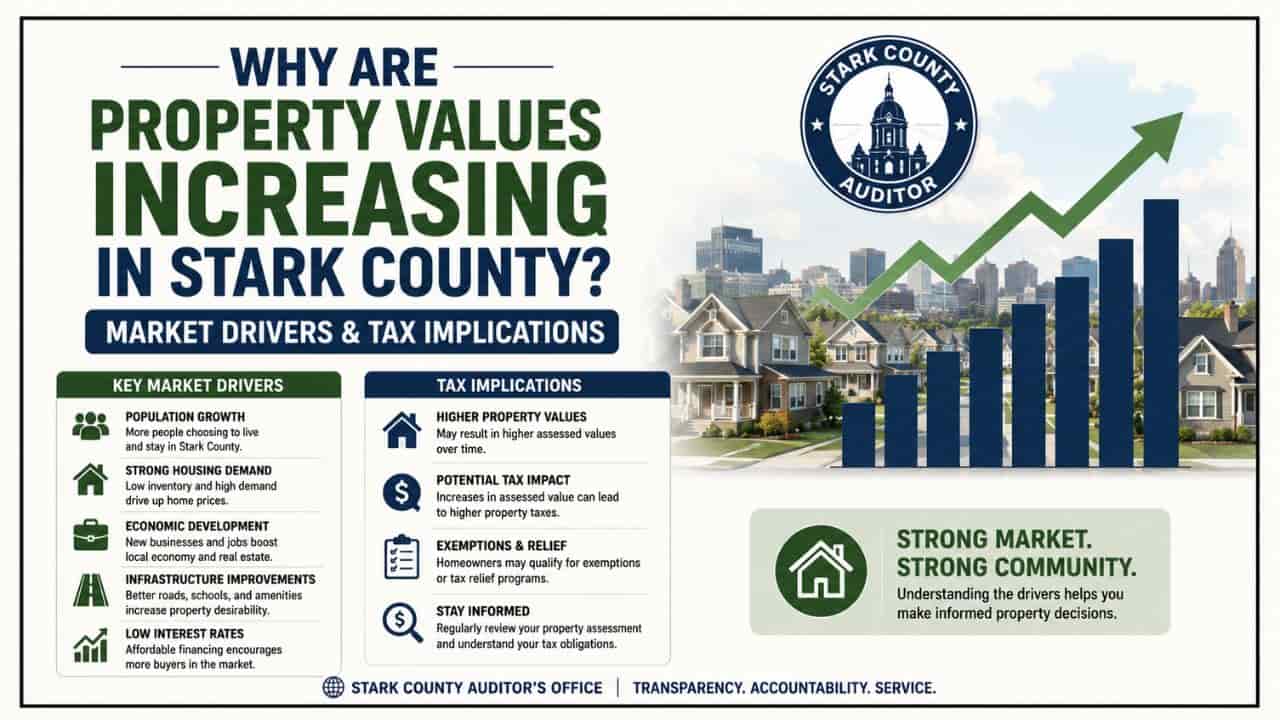
Understanding Stark County, Ohio property tax rates requires navigating a localized framework of millage rates, state mandated assessment ratios, and tax reduction factors. These levies fund essential public infrastructure, including local school districts and emergency services. For homeowners and real estate investors, analyzing how the Stark County Auditor calculates these assessments is critical for accurate financial planning and securing tax relief. This definitive guide demystifies the administrative mechanics of your local real estate tax bill, showing you exactly how rates are established, calculated, and legally minimized under current Ohio law.
The Administrative Mechanics: Gross vs. Effective Millage
Property tax rates in Ohio are expressed in mills. One mill represents $1.00 of tax for every $1,000 of a property’s assessed taxable value. When examining Stark County tax rate sheets, you will encounter two separate figures for each tax district: the Gross Tax Rate and the Effective Tax Rate.
- Gross Tax Rate: This is the total rate enacted by local legislative authorities and approved by voters via local levies. It represents the baseline statutory rate before any statutory economic adjustments are calculated.
- Effective Tax Rate: This is the actual rate applied to your property value. Under Ohio House Bill 920 (HB 920), passed in 1976 and codified in Ohio Revised Code (ORC) Section 319.301, tax reduction factors are calculated annually to prevent inflation from automatically increasing tax revenues on voted levies. As property values rise during county-wide reappraisals, the effective millage rate is scaled down to ensure that a taxing authority collects the exact dollar amount originally approved by voters.
The only portion of your tax bill immune to HB 920 reduction factors is inside millage. The Ohio Constitution guarantees local governments the right to levy up to 10 mills of unvoted (“inside”) property tax, which rises and falls in direct proportion to real estate market shifts.
Step by Step Breakdown of the Property Tax Calculation
Ohio uses a multi-tiered statutory formula to convert an unadjusted market value into a finalized annual real estate tax obligation. To calculate your estimated liability, follow this structured administrative sequence.
Step 1: Establish the Assessed Taxable Value
Pursuant to ORC Section 5713.03, real property taxes in Ohio are not levied on 100% of a property’s market value. Instead, the state mandates a uniform assessment rate of exactly 35%.
Assessed Taxable Value = Auditor Appraised Market Value x 0.35
Step 2: Apply the Local District Millage Rate
Locate your specific tax district on the official Stark County tax rate sheet. Divide the local Effective Tax Rate by 1,000, then multiply it by your Assessed Taxable Value to establish your baseline gross tax liability.
Gross Tax = Effective Millage Rate divided by 1000 multiply by Assessed Taxable Value

Step 3: Deduct Ohio Statutory Rollbacks and Credits
The state of Ohio automatically applies non-business credits to qualified properties and provides targeted reductions for primary residences. Subtract these percentages alongside any individual exemptions (such as the Homestead Exemption) to arrive at your final net annual property tax obligation.
Comprehensive District Comparison: Tax Year 2024 (Collected in 2025/2026)
Property tax rates across Stark County vary dramatically depending on city boundaries, township lines, and local school district allocations. The following data highlights the total statutory tax rates per $1,000 of taxable value across key regional tax districts.
| Taxing Jurisdiction | Local School District | Total Effective Tax Rate (Per $1,000) |
| Canton City | Canton City School District | 106.60 |
| Alliance City | Alliance City School District | 79.00 |
| Massillon City | Massillon City School District | 71.30 |
| Massillon City | Tuslaw Local School District | 80.80 |
| Lake Township | North Canton City School District | 112.40 |
| Plain Township | North Canton City School District | 120.85 |
| Sandy Township | Sandy Valley Local School District | 72.50 |
| Sugarcreek Township | Fairless Local School District | 68.30 |
| Tuscarawas Township | Tuslaw Local School District | 83.30 |
| Washington Township | Louisville City School District | 83.35 |
Local Trend Note (North Canton): Following local legislative and voter adjustments, including the implementation of the Issue 4 income tax adjustments, property owners within the City of North Canton have seen structural shifts in their municipal millage allocations, specifically affecting local fire, EMS, and street infrastructure levies.
Special District Assessments and Overlays
Your total real estate tax bill includes secondary voter-approved overlays that fund specialized regional entities. These districts ensure essential services are maintained independently of municipal and school operating budgets. If your parcel falls within these geographic or administrative boundaries, the following flat millage assessments are added directly to your composite tax rate:
- Stark County Park District: 1.00 mill
- Tri-Division Ambulance District: 4.00 mills
- Quad Ambulance District: 6.00 mills
- Mohawk Valley Joint Fire District: 3.50 mills
- Navarre-Bethlehem Joint Fire District: 3.50 mills
- Sandy Creek Joint Fire District: 7.00 mills
Public Library District Overlays
Library systems across Stark County are funded through dedicated, localized real estate levies. These rates are applied based on your specific school district boundaries:
- Massillon Public Library: 2.90 mills
- Canal Fulton Public Library: 2.00 mills
- North Canton Public Library: 1.50 mills
- Rodman Public Library (Alliance): 1.50 mills
- Louisville Public Library: 1.00 mill
State Mandated Property Tax Relief Programs
The Ohio Department of Taxation, in tandem with the Stark County Auditor’s Office, administers several statutory credits designed to mitigate real estate tax burdens. These rollbacks must be proactively filed or verified to ensure accurate billing.
1. Non-Business Credit
Formally known as the 10% rollback, this program automatically applies a 10% reduction to the voted levy portion of property tax bills for Class I real property (which encompasses all residential and agricultural acreage). This credit is restricted to non-commercial properties.
2. Owner-Occupancy Credit
Homeowners who own and occupy a property as their principal place of residence as of January 1st of the tax year qualify for an additional 2.5% tax reduction. This rollback applies strictly to the taxpayer’s primary dwelling and does not extend to secondary homes, vacation rentals, or commercial real estate holdings.
3. The Homestead Exemption
Codified under ORC Section 5721.06, the Homestead Exemption shields a portion of a home’s value from local taxation. This program allows eligible senior citizens (aged 65 and older) and permanently disabled individuals who meet state-mandated income thresholds to deduct up to $\$25,000$ of the market value ($\$8,750$ in assessed taxable value) from their home’s tax basis. Qualifying disabled veterans may be eligible for an expanded exemption of up to $\$50,000$ of market value.
4. Current Agricultural Use Value (CAUV)
Under Ohio’s uniform tax rules, farmland can be appraised based on its current agricultural operating value rather than its highest and best potential commercial use. To qualify for CAUV status, parcels must consist of at least 10 acres devoted exclusively to commercial agriculture, or generate a proven average gross income of at least $\$2,500$ over the preceding three year timeline.
Conclusion
Successfully managing your personal or commercial real estate investments in Northeast Ohio requires a comprehensive understanding of Stark County Ohio property tax rates. By monitoring the Stark County Auditor’s statutory revaluation cycles, evaluating the effective millage adjustments mandated under Ohio House Bill 920, and capitalizing on owner-occupancy rollbacks or agricultural CAUV programs, taxpayers can accurately control their annual financial liabilities. Utilizing these official municipal datasets ensures your property transactions, budgeting workflows, and portfolio expansions remain completely data-driven, mathematically precise, and legally compliant.
FAQs
How are Stark County property taxes calculated?
Multiply property market value by 35% to get taxable value. Multiply that by your local district’s millage rate, then deduct eligible credits/exemptions.
What is the current total tax rate in Stark County?
Rates vary heavily by district. They range from around 68.30 mills in Sugarcreek Township to 120.85 mills in Plain Township per $1,000 of taxable value.
Are there reductions available for homeowners?
Yes. Reductions include non-business credits, owner-occupancy credits, special reductions, and the homestead exemption for qualified senior citizens or disabled residents.
How can I check my property’s taxable value?
You can instantly look up your specific property’s assessed and taxable values using the online property search portal on the Stark County Auditor’s website.
Do special districts affect property taxes?
Yes. Additional levies from special districts, like local libraries, fire departments, parks, and ambulance services—are added depending on your property’s exact location.