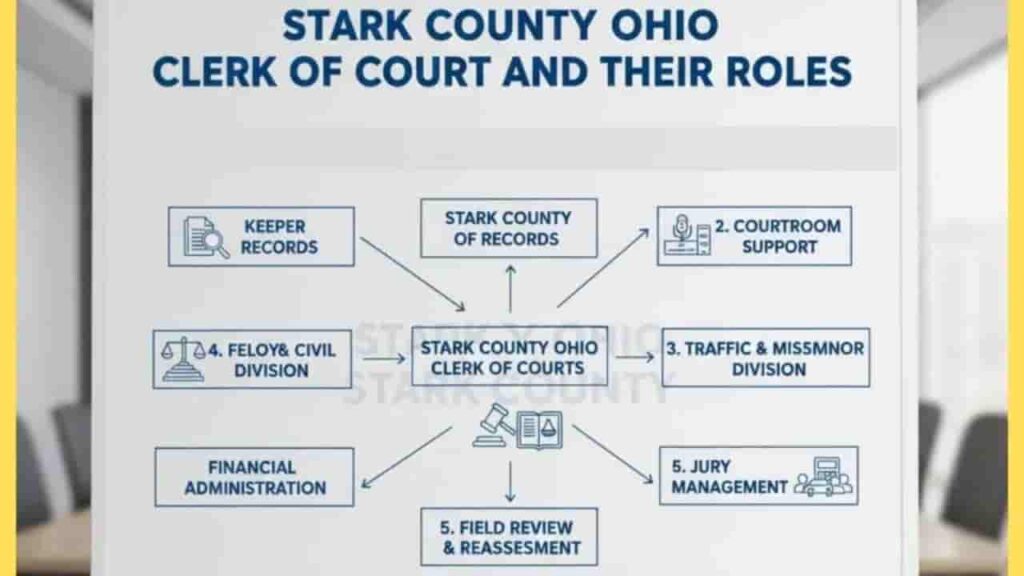
The administrative integrity of the Stark County, Ohio judicial system relies directly on the Stark County Clerk of Courts. Operating as an independent, elected official under statutory Ohio law, the Clerk serves as the essential recordkeeper and fiscal manager for the county’s higher legal divisions. Failing to understand the proper role, distinct physical locations, and specialized filing boundaries managed by the Clerk can lead to rejected filings, delayed dockets, or unexpected administrative expenses. This expert guide details the exact legal responsibilities, distinct court divisions, financial obligations, and localized workflows overseen by the Stark County Clerk of Courts.
Who is the Stark County Clerk of Courts?
The Stark County Clerk of Courts is a countywide elected official chosen by voters to serve a four-year term under Ohio law. The current officeholder is Lynn M. Todaro, who manages the administrative infrastructure for the higher-level judiciary divisions across the county.
While a general overview might state that the office manages operations “across the county’s courts,” it is legally critical to distinguish their specific statutory reach under Ohio practice:
- Direct Custody: The County Clerk holds exclusive responsibility for the Stark County Court of Common Pleas (including the General Civil, Felony Criminal, Domestic Relations, and Appellate divisions).
- The Municipal Exception: Unlike some states, the countywide Clerk does not manage day-to-day records for local municipal courts. The municipal courts in Canton, Massillon, and Alliance maintain their own independent, separately elected or appointed Municipal Clerks of Court who process local misdemeanors, traffic tickets, and minor civil actions.
- The Probate Exception: Vermined by the Ohio Revised Code, the elected Probate Judge serves as their own ex-officio clerk. Therefore, estate management, adoptions, and marriage licenses are handled directly by the Probate Court’s internal staff, rather than Lynn M. Todaro’s main office.
The Clerk of Courts serves as the essential administrative bridge, maintaining record integrity through the centralized Criminal Justice Information System (CJIS) to guarantee transparency and legal compliance for all major filings.
Defining the Office: General vs Municipal Jurisdictions
In Stark County, public records administration is optimized by separating countywide general courts from local municipal courts. A common mistake made by self-represented litigants is attempting to file countywide Common Pleas documents with a localized municipal clerk, or vice versa.
The Stark County Clerk of Courts (General Division) holds exclusive, statutory responsibility for managing the high-tier legal records filed within the Court of Common Pleas in downtown Canton. Conversely, local municipal traffic tickets, minor ordinance violations, and small claims are handled by independent municipal clerks in their respective city jurisdictions.
| Court System Administration | Administrative Official | Primary Office Location | Core Data Scope |
| Stark County Court of Common Pleas | Lynn M. Todaro (Clerk of Courts) | 115 Central Plaza North, Canton, OH 44702 | Felony Criminal Indictments, Civil Actions over $15,000, Domestic Relations |
| Canton Municipal Court | Phil G. Giavasis (Municipal Clerk) | 218 Cleveland Ave SW, Canton, OH 44702 | Misdemeanors, Traffic Infracions, Small Claims up to $6,000 |
| Massillon Municipal Court | Johnnie A. Maier, Jr. (Municipal Clerk) | 2 Fitzgerald Ave SE, Massillon, OH 44646 | Western Stark County Local Violations, Evictions, Minor Civil |
| Alliance Municipal Court | MaryAnne Carper (Municipal Clerk) | 470 E Market St, Alliance, OH 44601 | Eastern Stark County Jurisdictional Dockets and Violations |
Core Responsibilities of the County Clerk of Courts
Pursuant to the Ohio Revised Code (ORC), the county clerk handles a broad range of responsibilities categorized into three distinct operational areas:
1. Public Case Records Management and CJIS Integration
The Clerk serves as the official custodian for all permanent legal pleadings, motions, and judicial orders in Stark County. These multi-court records are synthesized into the Stark County Criminal Justice Information System (CJIS). The CJIS platform creates public accessibility by indexing daily case activities. This allows attorneys, background researchers, and residents to review active public dockets, verify filed judgments, and inspect open litigation files transparently.
2. Legal Processing and Document Entry
Every civil complaint, felony indictment, and motion must enter the local justice system through the Clerk’s processing counter. Deputy clerks assign individual, serialized case numbers, process certified mail summons to notify defendants, and maintain the formal sequential history of the court docket.
3. Financial Accountability and Fee Distributions
The office collects and tracks extensive financial assets, operating under strict state auditing guidelines. The Clerk processes initial civil filing deposits, collects felony criminal fines, coordinates restitution distributions for victims of crime, and safeguards funds held in escrow during active real estate foreclosures or title disputes.
Special Divisions Managed by the Stark County Clerk
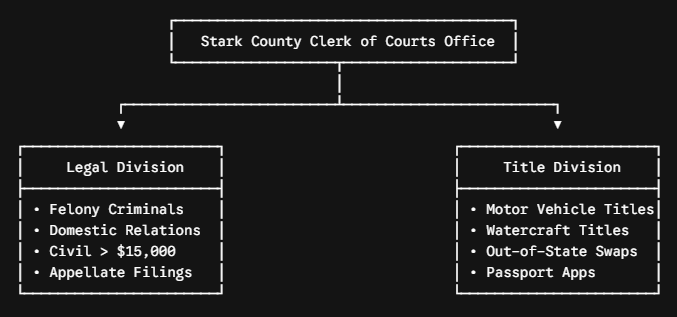
The main countywide Clerk’s office at 115 Central Plaza North handles two primary operational divisions, which are separated based on the legal objectives of the filings:
1. The Legal Division
The Legal Division handles all documentation for litigation within the Common Pleas framework. It manages the specialized filing counters for:
- The Civil Division: Processes high-value litigation exceeding $15,000, medical malpractice actions, and administrative zoning appeals.
- The Criminal Division: Registers formal grand jury indictments, tracks criminal bail bonds, and archives final sentencing decrees for felony offenses.
- The Domestic Relations Division: Files complaints for divorce, joint petitions for dissolution, and handles the subsequent tracking of court-ordered child support frameworks.
2. The Auto Title Division
Operating from a separate suite (110 Central Plaza South, Canton, OH), the Auto Title Division processes legal ownership certificates for motor vehicles and watercraft. Guided by Ohio Bureau of Motor Vehicles (BMV) regulations, this division handles out-of-state title conversions, processes lien notations for automotive lenders, issues salvage vehicle titles, and provides passport application services for local residents.
Step by Step Procedure: Requesting Certified Records
If you need a certified copy of a divorce decree, a civil judgment lien, or a felony case disposition for employment verification, lending approvals, or clean title verification, you must follow this structured administrative sequence:
1.Locate Your Case Number via CJIS:Case Index Search.
Navigate to the official Stark County CJIS online portal. Search by the primary party’s last name or corporate entity name to find and note the exact case number and filing year.
2.Verify the Proper Clerk Division Counter: Division Verification.
Ensure your target record is held by the county clerk. For family law or felony cases, utilize the Common Pleas Legal Division. For traffic violations or minor civil claims, contact the corresponding Municipal Clerk.
3.Submit Your Request and Pay Administrative Fees: Request Submission.
Present your targeted case details in person, via mail, or through the official web portal. Pay the required copy fees—typically $0.10 to $0.25 per standard page, plus a $1.00 statutory fee per document certification.
4.Verify and Secure the Certified Embossed Seal: Seal Verification.
Ensure the deputy clerk applies the official raised court seal to the document. This seal certifies the copy as an accurate, unaltered duplicate of the primary public archive, making it legally admissible for external agencies.
Conclusion
The Stark County Clerk of Courts acts as the administrative foundation of the local legal system. Understanding the division of duties between the countywide Common Pleas office and individual municipal clerks ensures your documentation is directed to the proper venue. By utilizing the CJIS network and following official procedures, citizens can confidently navigate filings, title transactions, and public record requests.
FAQs
Who is the current Stark County Clerk of Courts?
The Stark County Clerk of Courts is an elected official. Lynn M. Todaro currently holds the office, managing records for the Court of Common Pleas.
Does the Stark County Clerk manage traffic tickets?
No. Countywide traffic citations and speeding tickets are handled independently by the municipal court clerks in Canton, Massillon, or Alliance, depending on the violation location.
Where do I file for a marriage license in Stark County?
Apply directly at the Stark County Probate Court. Under Ohio law, the Probate Judge acts as their own clerk for marriage licenses and estates.
How can I look up Stark County court records online?
Use the centralized Stark County Criminal Justice Information System (CJIS) portal to conduct a free public records case search by name or case number.
What is the difference between the Legal and Title divisions?
The Legal Division processes court filings like felony indictments and divorces, while the Auto Title Division issues motor vehicle titles and handles passport applications.