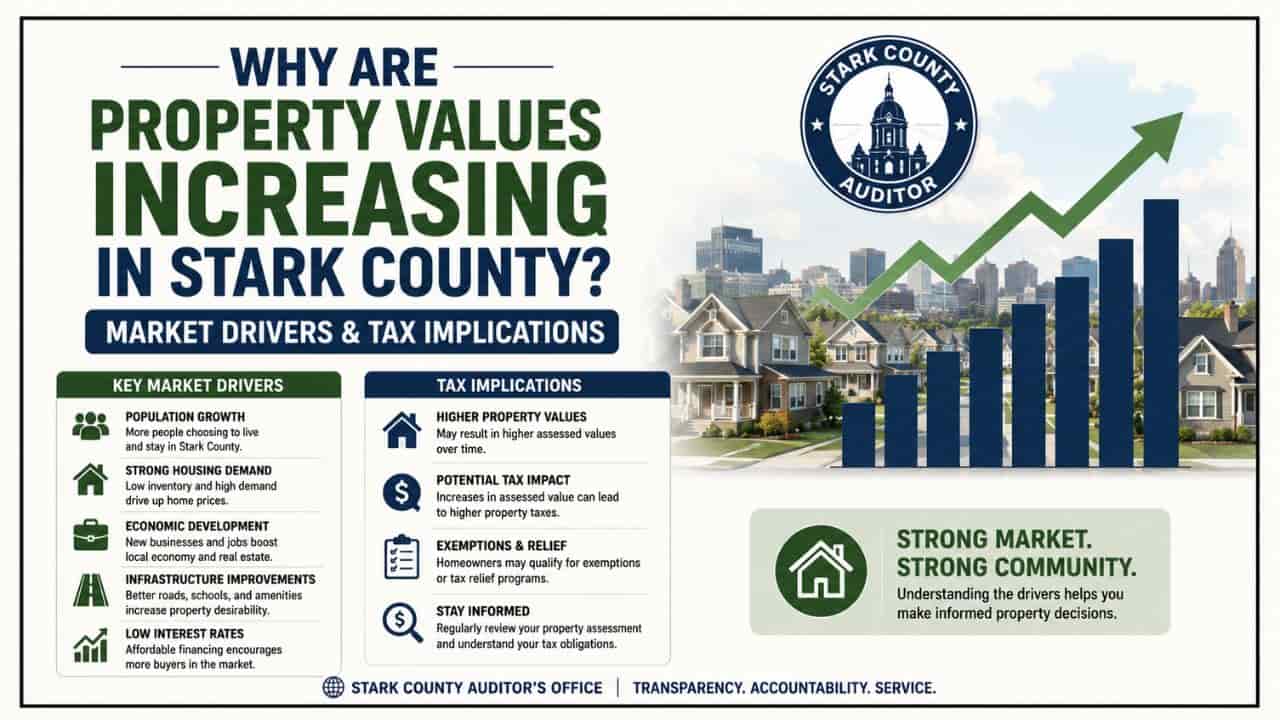
Filing a formal Stark County property value complaint is the most effective statutory mechanism to combat overassessment and protect your real estate yields. When the Stark County Auditor applies automated macro-appraisals, localized property defects, physical damage, or micro-market shifts are often overlooked, leading to inflated tax liabilities. By leveraging the Stark County Board of Revision (BOR) during the annual open filing window, real estate stakeholders can legally present objective market evidence, adjust incorrect property cards, and align their taxable footprints with true market conditions.
The Legal Framework: Stark County Board of Revision (BOR)
A property value challenge is a formal administrative legal proceeding. Under ORC Section 5715.01, every Ohio county operates a Board of Revision to hear evaluation disputes. In Stark County, this board is composed of three top county officials or their designated representatives:
- The Stark County Auditor (Secretarial and administrative lead)
- The Stark County Treasurer
- The President of the Stark County Board of Commissioners
The BOR has the quasi-judicial authority to alter property valuations based on evidence presented by the property owner. It is important to know that the Board does not have the power to change your tax rates or levy structures; it only rules on the total fair market value of the land and improvements.
Statutory Timelines and Valuation Metrics
Challenging your assessment requires strict adherence to statutory filing windows and a deep understanding of how property taxes are computed in Stark County.
| Statutory Parametric Layer | Rule Framework & Deadlines | Governing Ohio Revised Code (ORC) |
| Annual Filing Window | January 1 to March 31 (Strictly enforced; postmarks after March 31 result in jurisdictional dismissal). | ORC § 5715.19 |
| Filing Frequency Limit | Once every three-year interim period (Triennial update cycle), unless specific structural changes occur. | ORC § 5715.19(A)(2) |
| Tax Assessment Ratio | Taxes are calculated on an assessed value set exactly at 35% of market value. | ORC § 5715.01 |
Step by Step Guide: Filing the DTE 1 Valuation Complaint
To execute a property valuation appeal that stands up to county scrutiny, follow this precise sequence.
Step 1: Analyze Your Current Auditor Property Card
Begin by accessing the Stark County Auditor Property Search portal (realestate.starkcountyohio.gov). Pull up your property card using your 7-digit parcel identification number. Check the structural data layers for inaccuracies.
Verify Total Square Footage ➔ Audit Room/Bathroom Counts ➔ Check Land Use Codes ➔ Note Appraised Market Value
If the Auditor’s system lists your home as having finished areas or outbuildings that do not exist, you have clear ground for a data-driven correction.
Step 2: Establish Your Valuation Formula
Calculate the baseline variance before filling out paperwork. Your target argument must prove that the Auditor’s appraised market value is higher than actual market conditions. Remember the statutory taxable ratio:
Taxable Assessed Value = Auditor Market Value x 0.35
Step 3: Gather Legally Defensible Evidence
The Stark County BOR will dismiss complaints based on casual opinions or subjective complaints about “high taxes.” You must back up your requested reduction with authentic, objective documentation:
- Arm’s-Length Sale Settlement: If you purchased the asset within the last three years for less than the Auditor’s valuation, submit your executed closing disclosure and warranty deed.
- Certified Fee Appraisal: A professional appraisal report prepared for financing or tax appeal purposes by an Ohio-licensed appraiser is considered the gold standard of evidence.
- Neighborhood Comparable Sales (Comps): Identify at least three properties within your immediate subdivision or a 1-mile radius that are highly similar in age, square footage, and build style, and have sold recently for less than your current valuation.
- Structural Damage Estimates: If your property suffers from settling foundations, fire damage, or outdated mechanical lines, supply dated photographs alongside written contractor repair estimates.
Step 4: Execute the Official DTE Form 1
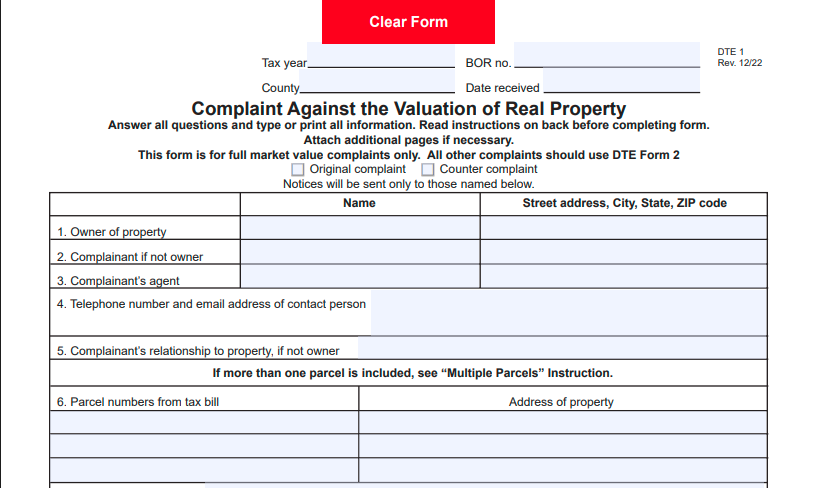
To file a formal complaint, you must fully fill out DTE Form 1 (Complaint Against the Valuation of Real Property).
Critical Execution Rule:
On Line 1, enter the exact legal name of the property owner as registered with the Stark County Recorder. If the property is held inside an LLC or a corporate entity, an officer of the firm or a licensed attorney must file the form to prevent unauthorized practice of law issues.
Make sure to include your 7-digit parcel ID, your current valuation, and your precisely calculated requested market value.
Step 5: File Your Packet with the Board of Revision
Submit the original signed DTE Form 1 along with all supporting evidence packets to the county office. You can deliver the files using three safe options.
Option A: In-Person Delivery to the Auditor’s Counter (Canton)
Option B: Certified Mail with Return Receipt Requested (For hard proof of delivery)
Option C: Official Secure Digital Portal (When actively supported on the Auditor’s site)
Step 6: Present Your Case at the BOR Hearing
Once your application is processed, you will receive an official notice by mail listing your assigned hearing date and time. Hearings take place in downtown Canton and generally last 10 to 20 minutes.
During the presentation, state your facts clearly, walk the board members through your physical or market evidence packets, and answer questions calmly. Avoid emotional complaints regarding municipal budgets.
Professional Strategy Notes for High-Value Portfolios
- Mind the Board of Education Counter-Complaints: In Ohio, local school districts receive the largest share of property tax revenues. Under recent changes to Ohio law, if you request a valuation reduction exceeding a certain threshold, the local Board of Education has the right to file a counter-complaint to protect their funding baseline. Be prepared for their legal counsel to cross-examine your appraisal evidence.
- Triennial Update Adjustments: Stark County property values are fully reassessed every six years, with statistical “interim” adjustments applied every three years. Reviewing your property tax standing immediately following a triennial update year ensures your portfolio values remain aligned with actual real estate trends.
Conclusion
Filing a timely Stark County property value complaint is a powerful administrative strategy to correct unfair tax assessments. By tracking the strict March 31 statutory window, executing the DTE Form 1 accurately, and presenting objective market evidence directly to the Stark County Board of Revision, real estate stakeholders can successfully lower inflated liabilities. Protecting your portfolio from automated overassessment ensures your local Ohio property investments remain optimized, profitable, and structurally sound.
FAQs
When is the absolute deadline to file a value complaint in Stark County?
The annual deadline is March 31. Under Ohio law, neither the Stark County Auditor nor the Board of Revision can grant extensions for late filings, regardless of the circumstances.
Can filing a value complaint cause my property taxes to go up?
Yes. While the primary goal of filing a complaint is to lower an over assessed value, the BOR has the statutory right to increase a valuation if the evidence shows the property is actually undervalued.
Do I need to hire an attorney to represent me at a BOR hearing?
If you own the property individually as a homeowner, you can legally represent yourself. However, if the asset is owned by an LLC, partnership, or corporation, Ohio law generally requires a licensed attorney to file the complaint and argue the case.
How long does it take for the Board of Revision to issue a decision?
Decision timelines vary based on total annual case volumes. Most filers receive a final determination notice via certified mail within six weeks to a few months after their live hearing.
What can I do if the Stark County BOR denies my reduction request?
If you disagree with the local board’s decision, you have the right to file an administrative appeal with the Ohio Board of Tax Appeals (BTA) or the Stark County Court of Common Pleas within 30 days of receiving your decision notice.