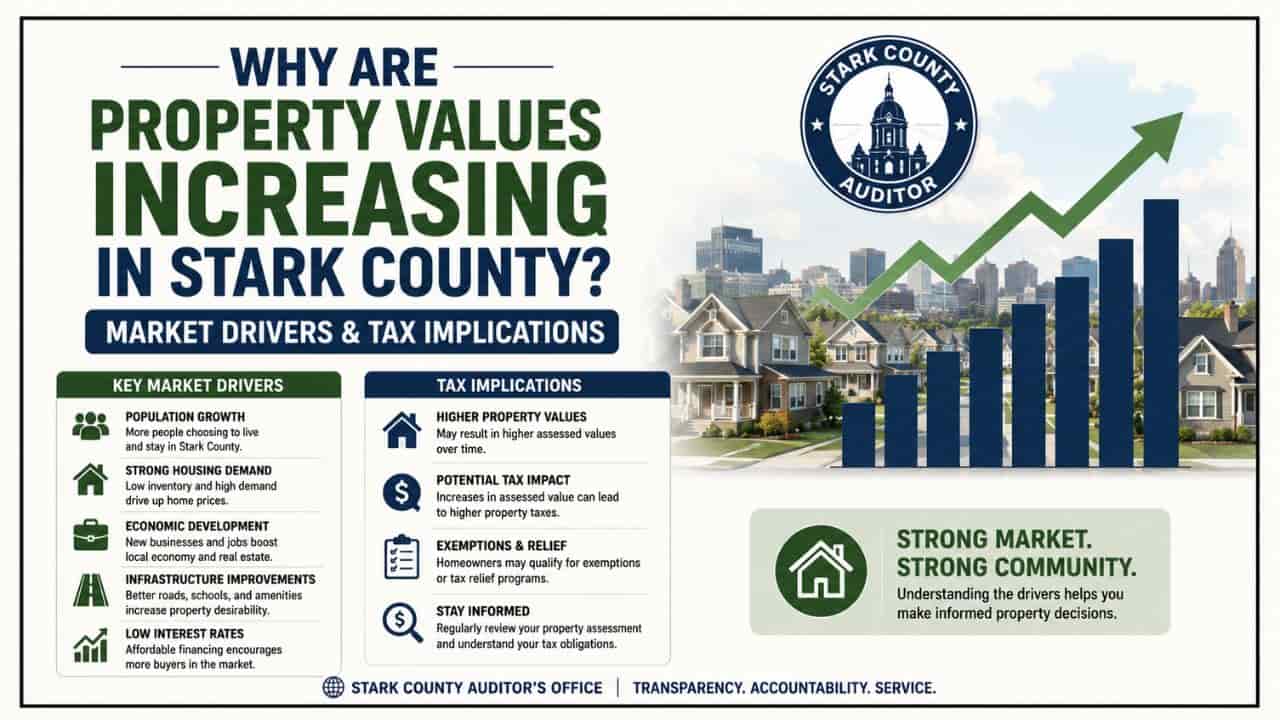
Understanding the financial structures of local municipal assessments is essential for property owners, businesses, and real estate developers across Northeast Ohio. In Ohio’s jurisdictional frameworks, real estate taxes are collected one year in arrears. This means your current calendar year payments represent the administrative tax obligations generated during the previous tax cycle. Through seamless coordination between the Stark County Auditor and the County Treasurer, these collected public funds are strategically channeled back into regional public infrastructure, preserving local community equity while successfully protecting your real estate portfolio’s final investment returns.
The Central Administrative Role of the Stark County Auditor
A common misunderstanding among local property owners is confusion over which government entity handles valuations versus who manages collections. The Stark County Auditor serves as the primary data administrator and mass appraisal authority for every parcel in the region.
Operating under the mandates of the Ohio Revised Code (ORC), the Auditor’s office executes several essential public record and structural functions:
- Triennial Appraisals and Sexennial Revaluations: Following statutory mandates, the Auditor performs a full physical appraisal of every property every six years (Sexennial Revaluation) alongside a statistical market update every three years (Triennial Update) to align county records with shifting local markets.
- Administration of Abstract Metrics: The Auditor’s office establishes the final Appraised Market Value for every residential, commercial, and agricultural property card. They apply specialized modifiers like the Current Agricultural Use Value (CAUV) calculation to reduce operational tax burdens for active regional farms.
- Millages Certification and Tax Indexing: The Auditor processes and certifies the exact localized voter-approved millage rates (tax levies) for each of the county’s distinct tax districts. One mill is structurally defined as $1.00$ of tax collection for every $1,000$ of taxable assessed value.
Where Your Tax Dollars Go: Statutory Allocation Analysis
Property tax revenues generated across Stark County do not flow into a single generalized government fund. Instead, they are split across several public service entities based on the precise taxing district lines of your home or parcel.
Total Tax Collected ➔ School Districts (60-65%) ➔ County Operations (15-18%) ➔ Municipalities / Townships (12-15%) ➔ Public Libraries & Special Districts (5%)
1. Public School Districts (Estimated 60% – 65%)
The largest portion of your local property tax allocation goes directly to public education. These funds sustain operating budgets, classroom resources, facility upgrades, and competitive wages for teachers across local school systems, such as Canton City, Massillon City, North Canton, and Jackson Local School Districts.
2. Stark County General & Operational Government (Estimated 15% – 18%)
This tier funds countywide administrative operations, infrastructure projects, and judicial enforcement systems. This includes funding for the Stark County Sheriff’s Department, regional common pleas courts, public health departments, and developmental disability service networks.
3. Local Municipalities and Townships (Estimated 12% – 15%)
Revenues kept by individual cities (like Alliance) or townships (such as Plain, Perry, or Lake) are used directly to support localized neighborhood services, including local police departments, fire and EMS teams, snow removal, and park maintenance.
4. Public Libraries and Special Environmental Districts (Estimated 5%)
The remaining funds support local public library systems, park districts (such as Stark Parks), and regional sanitary or joint ambulance districts.
Step by Step Property Tax Calculation Framework
To calculate your annual tax obligations in Stark County, public administrators follow a strict multi-step accounting process. Understanding this workflow allows you to verify the data on your annual tax bill for accuracy.
Step 1: Establish the Certified Assessed Value Baseline
In Ohio, property taxes are never calculated using 100% of your property’s appraised market value. Instead, the statutory calculation baseline is capped at an assessed value of exactly 35%:
Taxable Assessed Value = Auditor Appraised Market Value x 0.35
Example Calculation: If the Stark County Auditor values your home’s fair market appraisal at $200,000, your certified taxable baseline is calculated as follows.
$200,000 \x 0.35 = $70,000 Assessed Value}$$
Step 2: Apply the Combined Gross Millage Rate
Next, the county applies the total combined tax rate for your specific tax district. This rate includes all voter-approved school, township, and municipal millages.
Step 3: Implement Ohio Tax Reduction Factors
Before final billing, the state applies House Bill 920 reduction factors. This law caps tax collections on existing voter-approved levies to prevent inflation from automatically increasing school district revenues. It scales back the effective millage rate as overall property values climb.
Step 4: Subtract Eligible Exemptions and Credits
Finally, any eligible statutory tax credits are subtracted from your balance, including the Ohio Homestead Exemption for eligible seniors and disabled individuals, or owner-occupancy tax
The Collection Cycle: Stark County Treasurer Deadlines
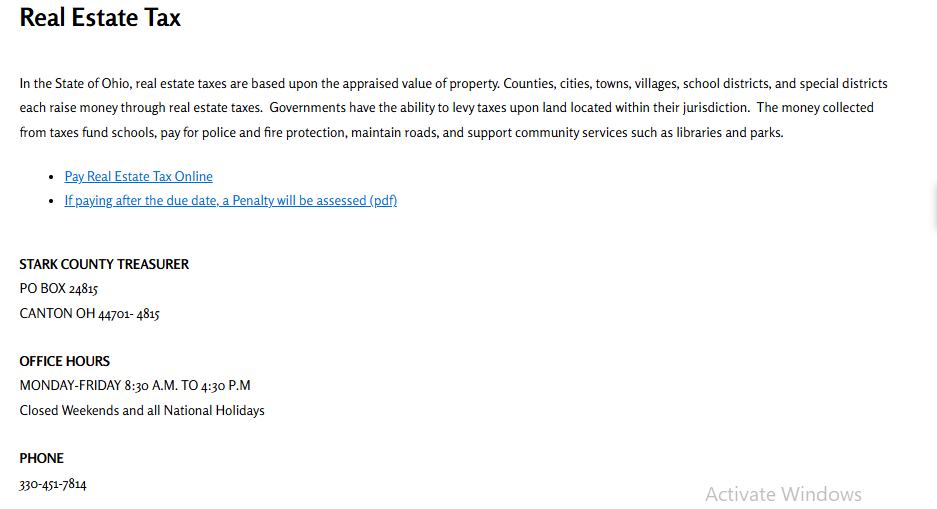
Once the Stark County Auditor finishes calculating tax values, the final property data rolls are transferred to the Stark County Treasurer for billing and collection.
Property taxes are split into two annual installments:
- First-Half Settlement: Usually due in mid-to-late February of the billing cycle.
- Second-Half Settlement: Typically due in mid-to-late July or early August.
Late Payment Warning: Failing to submit your payments by the postmark deadlines listed on your statements triggers an automatic statutory 10% penalty on the past-due balance, plus ongoing interest fees.
Proactive Property Tax Optimization Framework
- Perform Regular Audits on Your Property Card:
Log on to the Stark County Auditor property search portal (realestate.starkcountyohio.gov) and double-check your property characteristics. If your card mistakenly lists unbuilt square footage, extra bathrooms, or outdated additions, your assessment may be artificially inflated. - File a Formal Valuation Appeal with the BOR:
If your property card shows an appraised market value higher than actual local sales trends or a recent independent appraisal, you have the right to file an official valuation complaint. These appeals must be submitted to the Stark County Board of Revision (BOR) between January 1 and the statutory deadline of March 31.
Conclusion
Effectively managing your real estate investments requires a clear understanding of Stark County Ohio property tax distribution. By monitoring the Stark County Auditor’s ongoing assessment schedules, tracking how tax dollars are shared across school and municipal districts, and verifying billing deadlines with the County Treasurer, property owners can optimize their finances. Using these public record tools ensures your local real estate assets remain accurately valued and financially secure.
FAQs
How do I determine my specific Stark County property tax rate?
You can look up your exact tax rate by entering your parcel information into the Stark County Auditor property search engine. The system will display your current tax district number along with a breakdown of your gross and effective millage rates.
What is the difference between Gross Millage and Effective Millage?
Gross millage represents the total initial tax rate approved by local voters. Effective millage is the actual rate applied to your bill after accounting for Ohio House Bill 920 reduction factors, which lower the rate to protect homeowners from inflation-driven tax increases.
How do I apply for the Stark County Homestead Exemption?
Eligible senior citizens (aged 65 or older) and permanently disabled individuals can file an application for the Homestead Exemption through the Stark County Auditor’s office. This program exempts the first $26,200 of a home’s market value from local property taxes.
Can my property tax bills change if I do not make structural changes to my home?
Yes. Your tax bill can fluctuate if voters pass new local school, fire, or infrastructure levies, or if the county updates its property valuations during statutory triennial or sexennial valuation updates.
Who should I contact if I have questions about property tax payments or due dates?
For questions regarding tax billing statements, payment options, or deadlines, contact the Stark County Treasurer’s Office. For questions about property valuations, acreage assessments, or exemptions, contact the Stark County Auditor’s Office.