For property owners and entrepreneurs across Canton, Massillon, and Alliance, navigating municipal operations can be challenging. In Ohio’s local tax framework, the Stark County Auditor serves as both Chief Assessment Officer and Chief Fiscal Officer. While the Treasurer exclusively collects payments, the Auditor evaluates real estate market values, calculates millage rates, manages public regional payroll funds, and issues mandatory commercial vendor licenses. This expert guide breaks down these statutory administrative responsibilities step by step, helping you understand official county property valuations, protect your real estate equity, and maintain regulatory business compliance.
1. Real Property Appraisal and Mass Assessment
The most visible role of the Stark County Auditor is establishing the fair market value of all real estate parcels within county lines. Under the Ohio Revised Code (ORC), these values serve as the structural baseline for calculating annual property tax liabilities.
The Six-Year Valuation Cycle
Ohio mandates that every county follow a strict timeline to align property assessments with local housing market trends. The Auditor manages this process using two distinct methods:
- Sexennial Reappraisal (Every 6 Years): A comprehensive evaluation of every commercial, industrial, and residential parcel in Stark County. This process involves property data verification and structural reviews to account for neighborhood economic changes, new construction, or major physical improvements.
- Triennial Market Update (Every 3 Years): A statistical adjustment occurring exactly midway through the six-year cycle. The Auditor does not perform physical inspections during this phase. Instead, the office analyzes localized sales ratios and market shifts to ensure assessments match true market value.
Market Value vs. Assessed Value
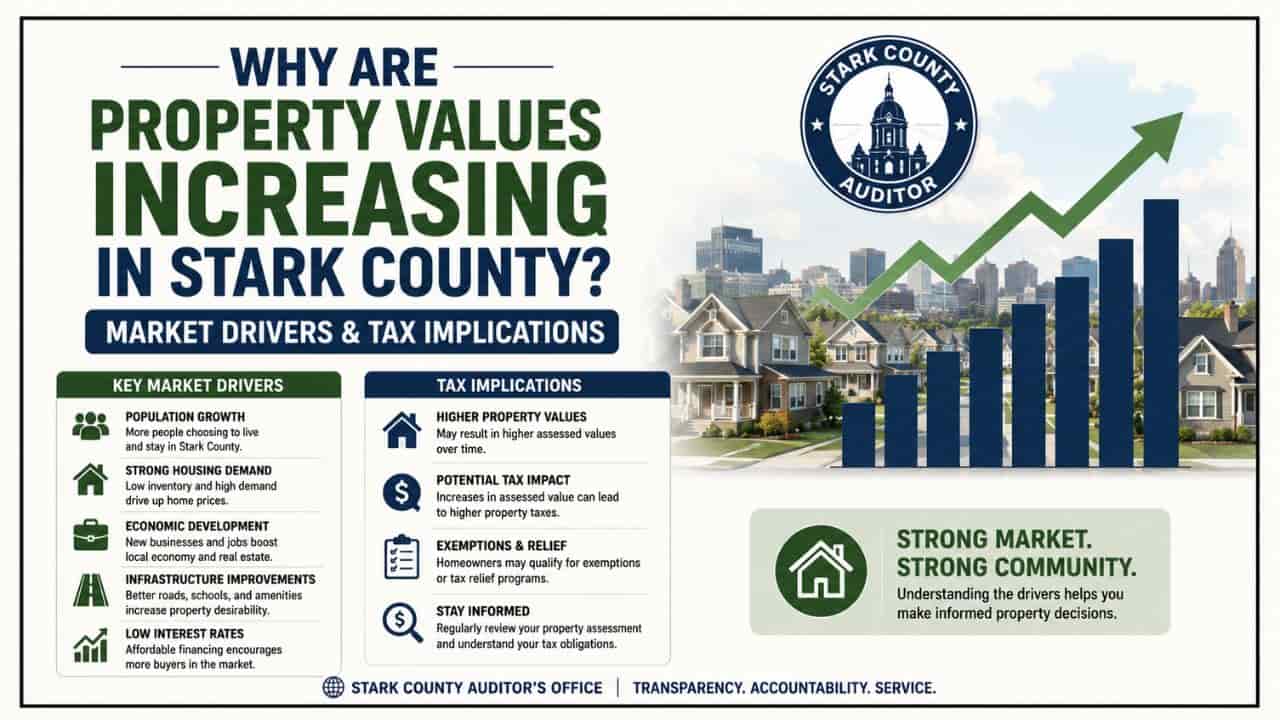
A common misunderstanding among Ohio property owners is the difference between market value and taxable assessed value. The Auditor determines the appraised market value based on what a property would sell for in an open, competitive market. However, your tax bill is applied to the Assessed Value, which is legally locked at exactly 35% of the market value.
Assessed Value = Market Value} x 0.35 $
2. Chief Fiscal Officer and Financial Steward
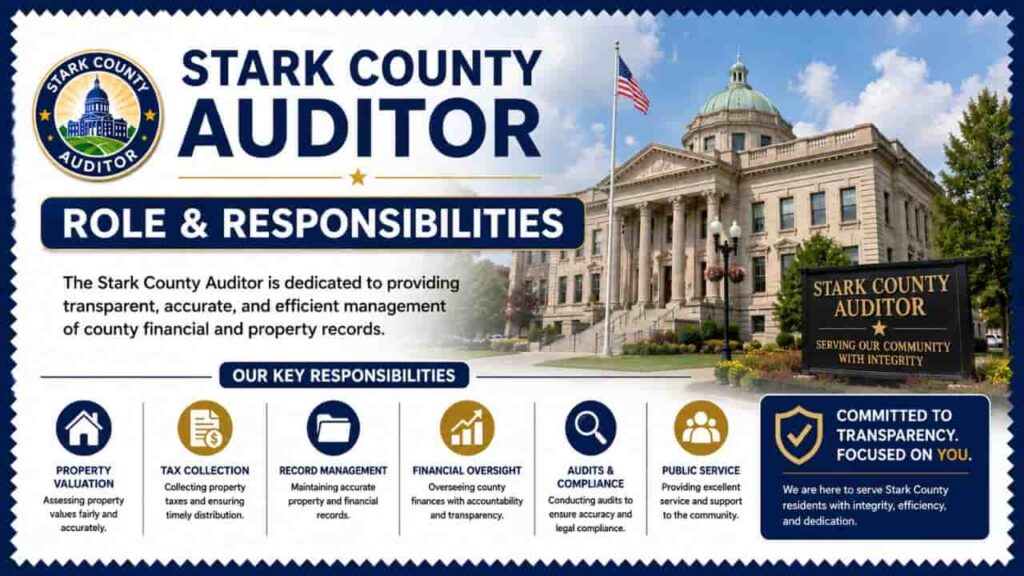
Beyond real estate appraisals, the Stark County Auditor functions as the Chief Fiscal Officer (CFO) for the entire regional government network. The Auditor’s accounting department tracks public money, distributes funds, and manages general payroll operations.
Core Financial Responsibilities
- Paymaster for Local Government: The Auditor processes payroll for all county employees and issues official warrants (checks) to clear operational obligations for public entities, human services, and judicial departments.
- The Budget Commission Secretary: Serving alongside the County Treasurer and Prosecuting Attorney, the Auditor reviews the annual tax budgets submitted by school districts, libraries, and local townships.
- Fund Distribution: After the Stark County Treasurer collects semi-annual property taxes, the Auditor calculates and distributes those revenues to the appropriate school districts, municipal infrastructure funds, and emergency services.
3. Statutory Tax Reductions and Savings Programs
To protect residential equity and support the regional agricultural economy, the Stark County Auditor administers several statutory tax relief programs. Eligible property owners must file applications directly with the Auditor’s office.
Key Tax Reduction Initiatives
- The Homestead Exemption: Provides significant property tax relief to qualifying low-income seniors (aged 65 and older) and permanently disabled individuals by exempting a portion of their home’s market value from local taxation.
- Owner-Occupancy Credit: A automatic 2.5% reduction applied to the tax bills of individuals who own and occupy their primary residential structure in Ohio.
- Current Agricultural Use Value (CAUV): A critical program for farmers and rural land investors. Instead of evaluating working farmland at its “highest and best use” (such as speculative commercial developments), the Auditor assesses the land based entirely on its commercial agricultural productivity and specific soil classifications.
4. Consumer Protection: Weights and Measures
An overlooked but vital duty of the Stark County Auditor is protecting consumers through the Weights and Measures Department. Deputy inspectors travel throughout Northeast Ohio to verify that commercial scale and measuring devices are completely accurate.
Statutory Enforcement: Under Ohio law, every commercial device used to sell products by weight, length, or count must be tested and stamped with an official tracking seal annually.
This department directly inspects and certifies:
- Gasoline pumps (checking both volume accuracy and fuel quality standards)
- Retail price scanners at supermarkets and convenience stores
- Commercial meat, deli, and livestock scales
- Timers on laundromat dryers and parking infrastructure
5. Licensing and Business Permits
The Stark County Auditor serves as the primary regional administrative agent for local business registration and state-mandated licensing. If your business operates within county lines, you must obtain appropriate clearance from the Auditor to maintain regulatory compliance.
Mandatory County Licenses
The table below outlines the primary licensing frameworks managed by the Auditor’s office, including their statutory purpose and application scope.
| License Type | Governing Authority | Primary Purpose & Application Scope |
| Vendor License | Ohio Dept. of Taxation | Authorizes brick-and-mortar retail entities to legally conduct taxable sales and collect sales tax within Stark County. |
| Cigarette License | Ohio Revised Code | Required for any gas station, convenience shop, or wholesale business selling commercial tobacco products to consumers. |
| Dog / Kennel License | State of Ohio | Mandatory annual registration for all canine owners to ensure public safety tracking and support local animal control structures. |
6. Resolving Valuation Disputes: The Board of Revision
When an assessment exceeds true market value due to hidden structural defects, inaccurate square footage records, or localized economic shifts, property owners have a statutory right to contest the value.
The Auditor serves as the permanent secretary of the Stark County Board of Revision (BOR). Property owners can file a formal valuation complaint (typically between January 1 and March 31) to present evidence such as recent independent appraisals or comparable sales data to secure a lower taxable valuation and reduce recurring overhead costs.
Conclusion
Navigating the statutory infrastructure managed by the Stark County Auditor is essential for regional fiscal compliance. From calculating property assessments during the triennial update to auditing commercial weights and issuing vendor licenses, this agency protects both taxpayer equity and local business integrity. Aligning your real estate assets or corporate filings with official Auditor data ensures administrative accuracy, mitigates legal penalty risks, and unlocks substantial tax reductions across Northeast Ohio.
FAQs
What is the primary role of the Stark County Auditor?
The Auditor serves as Chief Fiscal Officer and Chief Assessment Officer, establishing real estate market values, administering local tax reductions, and issuing commercial operating licenses across the county.
How do I appeal a property valuation in Stark County?
You can contest inaccurate property appraisals by filing a formal valuation complaint with the Stark County Board of Revision between January 1 and March 31 annually.
Where is the Stark County Auditor’s office located?
The main administrative headquarters is located at the Stark County Office Building, 110 Central Plaza South, Suite 220, Canton, Ohio 44702, for in-person filings and deed transfers.
Does the Auditor collect property tax payments?
No. The Stark County Auditor calculates the property assessment and tax rate liabilities, while the Stark County Treasurer is exclusively responsible for billing and collecting the actual payments.
How often does the Auditor update property values?
Ohio law mandates a comprehensive physical reappraisal every six years, with a statistical localized sales market adjustment occurring midway through the cycle during the triennial update.