Conveying real estate titles in Canton, Massillon, and Alliance requires a precise understanding of the legal instruments used to transfer property ownership. In Ohio, selecting between a General Warranty Deed and a Quitclaim Deed dictates the legal protections a buyer receives, the liabilities a seller retains, and whether title insurance companies will clear the transaction. This definitive guide breaks down the ten structural differences between these two primary deeds under the Ohio Revised Code, ensuring your next Stark County property transfer remains fully compliant and legally protected against costly title disputes.
The Core Structural Differences: An Overview
Before diving into the detailed legal mechanics, it is essential to understand the basic division between these two deeds.
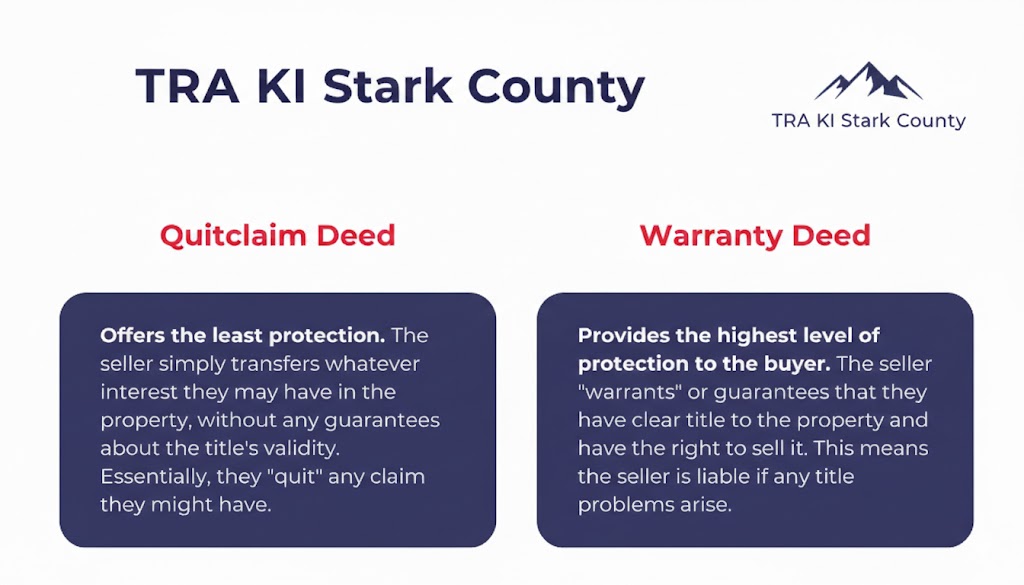
- The General Warranty Deed acts as a comprehensive legal promise, guaranteeing the history of the title from the original land patent down to the current transfer.
- The Quitclaim Deed acts simply as a release form, conveying only the current interest the grantor may hold at that exact moment, without promising that they actually own anything.
Stark County Conveyance Mapping
| General Warranty Deeds | Quitclaim Deeds |
| Traditional home sales | Intrafamily property gifting |
| Commercial property acquisitions | Divorce decree asset divisions |
| Financed real estate developments | Moving titles into an LLC or Trust |
10 Functional Differences Between Warranty & Quitclaim Deeds
1. Level of Legal Protection
The primary difference between warranty deeds and quitclaim deeds in Stark County involves the level of legal protection they provide during property transfers. Warranty deeds offer strong assurances that the seller holds clear, marketable title, while quitclaim deeds offer no guarantees at all. These contrasting levels of protection directly influence buyer confidence, seller responsibility, and overall transaction security.
2. Primary Localized Use Cases
Warranty deeds and quitclaim deeds are used in Stark County for very different purposes. Warranty deeds support traditional property sales requiring high legal certainty, while quitclaim deeds facilitate low-risk transfers between familiar parties. Understanding where each deed makes sense ensures buyers and sellers choose the safest and most appropriate document for their specific real estate situation.
3. Title Insurance Requirements
Title insurance companies evaluate warranty deeds and quitclaim deeds differently in Stark County due to their varying protections. Warranty deeds offer predictable, secure ownership, which insurers prefer, while quitclaim deeds create uncertainty. These contrasting risk levels impact the cost, approval speed, and depth of title investigation required before an insurance policy can be issued for the property.
4. Impact on Real Estate Closings
Real estate closings in Stark County, Ohio can vary significantly depending on whether a warranty deed or quitclaim deed is used. Warranty deed closings typically involve more verification, longer timelines, and additional steps due to ownership guarantees, while quitclaim deed closings are faster but lack protective measures. The selected deed influences the entire closing process and overall transaction efficiency.
5. Seller Responsibilities
Warranty deeds and quitclaim deeds impose different obligations on sellers during and after Stark County property transfers. A warranty deed requires sellers to guarantee clear ownership and defend the title if future disputes arise. In contrast, a quitclaim deed imposes almost no post-transfer responsibility, shifting all risk to the buyer and eliminating seller liability after recording.
6. Buyer Confidence in Stark County, Ohio
Buyer confidence varies greatly depending on the deed used. Warranty deeds instill trust by guaranteeing ownership, making them ideal for Stark County homebuyers. Quitclaim deeds, on the other hand, create uncertainty due to their lack of protections. These differences significantly influence how comfortable buyers feel and how willing they are to proceed with specific property transactions.
7. Lender Preferences
Mortgage lenders in Stark County strongly prefer warranty deeds because they guarantee clear title, reducing financial risks. Quitclaim deeds lack assurances, making them unsuitable for most financed purchases. These differing preferences affect whether a buyer can obtain financing, how quickly approval occurs, and whether certain transactions qualify for traditional mortgage-backed lending programs within the county.
8. Handling Title Defects
Warranty deeds and quitclaim deeds handle title defects very differently. Warranty deeds require sellers to clear any issues before transfer and assume responsibility for future claims. Quitclaim deeds transfer ownership regardless of defects, leaving buyers to resolve problems alone. These contrasting approaches determine how title complications are managed during Stark County property transactions.
9. Conveyance Fee Calculations and Recording Process
Recording warranty deeds and quitclaim deeds in Stark County follows similar physical procedures, but the documentation requirements and financial verification depth differ. Both deeds must pass through the Stark County Auditor’s Office for tax assessment before recording. Warranty deeds often require more detailed legal description verification due to their permanent guarantees, while quitclaim deeds undergo a quicker processing path because they transfer only available interest.
10. Suitability for Different Situations
Warranty deeds and quitclaim deeds serve entirely different purposes depending on the transaction’s nature. Warranty deeds are ideal for commercial sales, financed purchases, and transactions requiring full ownership protection. Quitclaim deeds are best for family transfers or administrative corrections. Selecting the right document helps ensure secure, predictable, and appropriate property transfers across Stark County’s diverse real estate market.
Step by Step Property Conveyance Guide
To execute a flawless property transfer within Stark County without triggering compliance rejections, follow this exact step-by-step procedure.
- Draft the Instrument with Exact Statutory Language:
Ensure the document uses explicit Ohio statutory terms, such as “grants with general warranty covenants” or “quitclaims to the grantee,” to legally define the protections being transferred. - Verify the Official Legal Description:
Copy the exact legal description and parcel number (PIN) from the property’s previous deed of record. Any typos or spatial errors will cause the Auditor’s office to reject the transfer. - Execute Before an Active Ohio Notary Public:
The grantor must sign the deed in the presence of an authorized notary public. Ohio law does not require witnesses, but the notary’s acknowledgment block must be flawless. - Submit to the Stark County Auditor for Stamping:
Take the signed deed and the completed Conveyance Fee Statement (DTE 100 or DTE 100EX) to the Auditor’s desk. Pay the mandatory county conveyance fee to receive the transfer stamps. - Record the Document to Secure Public Priority:
Deliver the stamped deed immediately to the Stark County Recorder. Paying the base recording fee ensures your transfer is officially indexed, establishing public priority and protecting your chain of title.
Conclusion
Choosing between a warranty deed and a quitclaim deed in Stark County depends entirely on the level of protection needed. Warranty deeds provide strong ownership guarantees, making them ideal for traditional sales, while quitclaim deeds support simpler, trust-based transfers. Understanding these differences helps buyers and sellers avoid problems, safeguard investments, and complete property transactions confidently and efficiently.
FAQs
Which deed is safer in Stark County?
A warranty deed is much safer because the seller legally guarantees clear title and promises to defend you against any future liens, claims, or legal disputes.
Can I use a quitclaim deed to sell a home?
Technically yes, but it is extremely rare. Traditional buyers and mortgage lenders will almost always demand a warranty deed to guarantee clean, unclouded property ownership.
Are quitclaim deeds legally valid in Stark County?
Yes. They are fully valid and ideal for quick, non-commercial property transfers, such as adding a spouse, gifting land to children, or moving assets into an LLC.
Do warranty deeds guarantee a perfect title?
Not automatically, but they guarantee the seller must legally fix or defend any title issues that surface later. Combining it with title insurance gives you maximum security.
Do both deeds need to be recorded in downtown Canton?
Yes. Both instruments must be stamped by the Auditor and filed at the Recorder’s Office to establish official public priority and protect your chain of title.