
Local school district levies and millage rates serve as the single most influential factors determining your final real estate liabilities on the Stark County property search portal. In Ohio, public education relies heavily on local property taxes, causing tax rates to vary drastically across communities. While local school boards propose funding initiatives, the Stark County Auditor’s Office holds the statutory responsibility to calculate and apply these voter-approved metrics. This expert guide breaks down the mathematics behind Ohio’s millage system, comparing structural tax differences across Canton, Massillon, and Alliance.
The Critical Role of the Stark County Auditor in Levy Management
To understand how school levies impact your finances, you must first recognize the administrative framework managed by the Stark County Auditor. In Ohio, the County Auditor serves as the chief fiscal officer and assessor for all local jurisdictions. The Auditor’s office does not write or enact tax laws, nor do they pass school levies. Instead, their job is to calculate and apply them.
When voters approve a school ballot initiative in their local district, the Auditor’s Real Estate Division steps in to handle the math:
- The Tax Duplicate: The Auditor maintains the master record of all real property valuations, known as the tax duplicate.
- Applying the Millage: The Auditor’s staff updates individual parcel files to ensure the correct voter-approved millage rates are applied to the proper geographic tax districts.
- Computing Reductions: The Auditor computes statutory tax reduction factors, such as those mandated by House Bill 920, to keep tax collections aligned with legal limits.
Solving the Math: What is a Mill and How Does It Function?
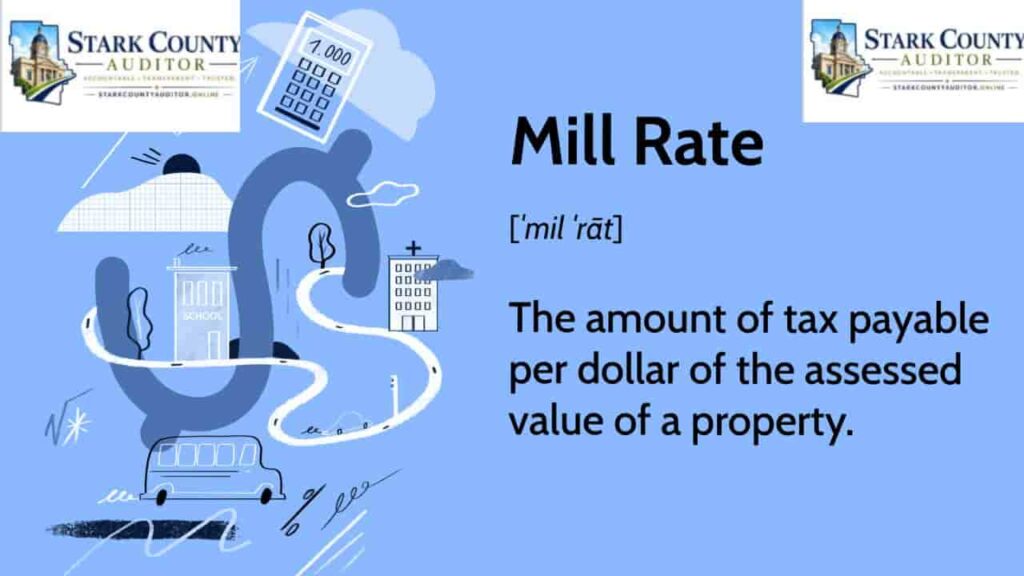
The word “millage” comes from the Latin word for a thousand (millesimum). In real estate finance and public accounting, one mill is equal to one-thousandth of a dollar, or $0.001.
1 Mill = $1 divided by $1,000 = $0.001
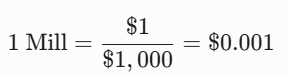
To put this in perspective, for every mill levied against your property, you owe exactly $1.00 for every $1,000 of taxable assessed value.
Gross Millage vs. Effective Millage
When researching local rates on the Stark County property search portal, you will see two distinct millage terms:
- Gross Millage Rate: This is the total, original tax rate approved by voters on a school district ballot.
- Effective Millage Rate: This is the actual rate you are billed after state-mandated inflation protections are applied. Due to Ohio’s House Bill 920 (HB 920), as property values rise due to market appreciation, effective millage rates are automatically scaled downward so that school districts do not collect unvoted windfall revenues from market growth.
Structural Tax Variations: Canton vs. Massillon vs. Alliance
Your physical address dictates your taxing district code. Because school district footprints do not perfectly align with city borders, adjacent neighborhoods can have completely different tax bills.
The following data matrix compares the core structural configurations of the three primary school taxing frameworks in Stark County.
| School District Framework | Core Structural Jurisdictional Footprint | Primary Levy Focus & Tax Burden Profile |
| Canton City School District | Covers most urban properties within the City of Canton and select adjacent suburban areas. | Balances historic infrastructure maintenance with high-density student services. |
| Massillon City School District | Encompasses the City of Massillon and portions of western Stark County townships. | Strongly supported by local voters, focusing heavily on athletic facilities and specialized academic operations. |
| Alliance City School District | Focuses on the northeastern pocket of Stark County surrounding the University of Mount Union. | Relies on a combination of residential assessments and commercial industrial strips to fund operations. |
Why Rates Diverge
These districts operate with entirely separate effective millage rates. Canton property tax profiles may feature specific permanent improvement levies that Massillon properties do not have. Meanwhile, an Alliance real estate search might reveal unique emergency school levies designed to plug immediate budgetary deficits.
When you purchase real estate in Stark County, you are buying into that specific school district’s voter-approved financial history.
Step by Step Instructions: Calculating Your School District Tax Liability
To strip away the mystery of your tax bill, you can calculate your school levy liability manually. Follow this step-by-step mathematical roadmap.
[The Property Tax Math Pipeline]
Step 1: Appraised Market Value x 0.35 = Taxable Assessed Value
Step 2: Assessed Value x Effective Millage Rate (expressed as a decimal) = Gross Tax Due
Step 3: Gross Tax Due – State Non-Business / Owner-Occupancy Credits = Net Annual Tax Bill
Step 1: Isolate Your Taxable Assessed Value
In Ohio, property taxes are not calculated using 100% of your home’s appraised market worth. State law sets your taxable baseline known as the Assessed Value at exactly 35% of your fair market value.
Appraised Market Value x 0.35 = Assessed Value
$$\text{Appraised Market Value} \times 0.35 = \text{Assessed Value}$$
- Example: If the Stark County Auditor values your home at $200,000, your taxable base is.
$200,000 x 0.35 = $70,000
Step 2: Convert the Effective Millage to a Decimal
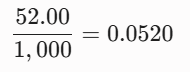
Locate the effective school millage rate for your specific tax district code on the Auditor’s website. For this example, let’s assume a total local effective school levy rate of 52.00 mills. To use this number in our calculation, divide it by 1,000 to convert it into a workable decimal format.
52.00 divided by1,000 = 0.0520
Step 3: Run the Base Multiplication
Multiply your taxable assessed value by the decimal millage rate to determine your raw annual school tax obligation before any state tax rollbacks or personal exemptions are applied.
$70,000 x 0.0520 = $3,640
In this scenario, $3,640 of your annual property tax bill goes directly toward funding local public schools, teacher salaries, facility maintenance, and classroom resources.
Local Administrative Offices and Verification Channels
If you are evaluating a potential real estate purchase, executing a commercial land development, or verifying an unvoted levy adjustment, you can access certified public ledger records directly from the county seat:
- Office Name: Stark County Auditor’s Office (Levy and Settlement Division)
- Physical Address: 110 Central Plaza South, Suite 220, Canton, OH 44702
- Online Verification: Use the official interactive Stark County property search terminal to download your property’s specific “Tax Distribution” data sheet, which details exactly which percentage of your tax dollars goes to schools versus county infrastructure.
Conclusion
Understanding millage rates is the key to demystifying your property tax bills across Stark County. Your final tax obligation is shaped by a structured combination of your property’s 35% taxable assessed value and the local school levies approved by voters in your community. By recognizing how effective rates adjust under House Bill 920 and understanding the structural differences between the school systems of Canton, Massillon, and Alliance, you can confidently audit your tax statements, anticipate future bill adjustments, and protect your real estate investments.
FAQs
What exactly is a millage rate in Stark County property tax calculations?
A millage rate is the local tax metric used in Ohio, where one mill equals one-thousandth of a dollar ($0.001). It represents a tax obligation of $1.00 for every $1,000 of your property’s taxable assessed value.
Why do properties in Canton have different tax bills than homes in Massillon?
Property tax bills vary because each city sits in a different school taxing district. Voters in Canton, Massillon, and Alliance pass different school levies, resulting in distinct local millage rates.
How does House Bill 920 protect Stark County homeowners from school tax hikes?
House Bill 920 automatically scales down effective millage rates when property values rise due to market inflation. This ensures school districts cannot collect more revenue from existing voted levies than originally approved.
Where can I see exactly how much of my tax money goes to local Stark County schools?
Look up your property on the official Stark County property search portal, open your property card, and click on the “Tax Distribution” tab to view a complete visual breakdown.
What percentage of my home’s market value is actually subject to tax levies?
In line with Ohio state tax codes, the Stark County Auditor calculates your real estate tax liability using an assessed value equal to exactly 35% of your home’s total appraised market value.