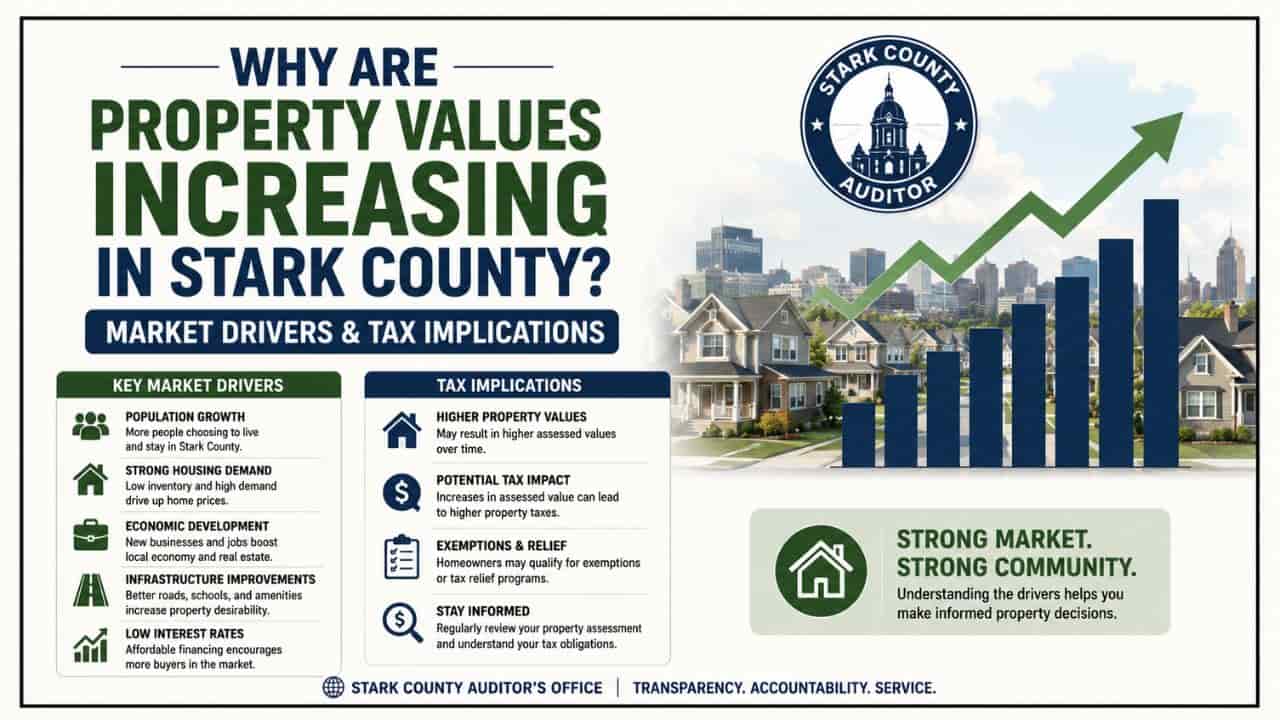
Ohio real estate is undergoing its most significant regulatory transformation in decades following Governor Mike DeWine signing five property tax reform bills. This historic legislation fundamentally reshapes how residential parcels are appraised, caps rapid tax growth, and reorganizes local funding structures. For property owners and developers across Canton, Massillon, and Alliance, these changes directly impact annual carrying costs. This definitive guide breaks down how the Stark County Auditor will implement these state mandated metrics, helping you understand the complex new laws to protect your real estate portfolio from financial risk.
The Regulatory Pillars of Ohio Property Tax Reform
The 2026 property tax overhaul consists of five companion bills designed to limit unvoted tax spikes, enhance regional transparency, and return administrative control to local county authorities.
| Assessment & Rate Controls | Relief & Credit Enhancements |
| HB 124: Localized Data Control | HB 186: 15.38% Owner Credit by 2029 |
| HB 129: Closes School Floor Loopholes | HB 186: Inflation Cap Credits |
| HB 335: Caps Inside Millage Growth | HB 309: Trims Excess Local Levies |
Assessment & Rate Controls: Focused strictly on structural stabilization, bringing data management back to local county lines, and stopping unvoted funding windfalls.
Relief & Credit Enhancements: Focused directly on primary residential relief by expanding direct owner rollbacks and putting strict inflation protection caps on local assessments.
Breakdown of the 5 Ohio Property Tax Reform Bills
1. House Bill 124: Local Control Over Reappraisal Metrics
House Bill 124 often called the Flip the Script Act fundamentally changes how the Ohio Department of Taxation (DOT) interacts with local assessments.
- The Shift: Previously, centralized state agencies used independent, external data samples to mandate broad adjustments during triennial updates and sexennial reappraisals.
- The Solution: HB 124 requires the state to use the specific open-market, arm’s-length sales samples supplied directly by the county auditor. This ensures property valuations reflect actual Stark County neighborhood trends rather than detached state-level formulas.
2. House Bill 129: Closing the 20-Mill School Floor Loopholes
School district taxes make up the largest percentage of individual Ohio property tax bills. Under previous laws, when a district hit its mandatory “20-mill floor” (the minimum effective rate required for basic operations), rising property values automatically triggered higher tax bills for homeowners without requiring a voter referendum.
- The Correction: HB 129 changes this structure by requiring fixed-sum levies (such as existing emergency and substitute levies) to be included inside the 20-mill floor calculation starting in tax year 2026. This calculation adjustment reduces automatic revenue windfalls and prevents unexpected tax hikes when regional home values rise.
3. House Bill 186: Inflation-Based Caps & Expanded Owner Rollbacks
House Bill 186 targets rapid, market-driven valuation jumps by establishing a formal “Inflation Cap Credit” for school district levies. If local real estate values rise faster than the rate of inflation (tied to GDP deflator metrics), taxpayers receive a offsetting credit to stabilize their bill.
- Primary Residence Boost: HB 186 phases out the old 10% non-business tax rollback on residential rental properties and redirects those funds exclusively to primary residents. The Owner-Occupied Tax Credit increases from its baseline of 2.5% up to a maximum of 15.38% by 2029, providing substantial relief to local homeowners.
4. House Bill 309: Strengthening County Budget Commission Oversight
House Bill 309 expands the authority of the three-member County Budget Commission (CBC), which is led by the county auditor.
- Rate Reductions: The CBC can now review and actively reduce voted local levy rates if public cash reserves are excessive or if the collected funds are deemed unnecessary for immediate operations. This creates an important safeguard against excessive local government spending.
5. House Bill 335: Inside-Millage Revenue Stabilization Caps
While HB 186 addresses voter-approved outside millage, House Bill 335 limits unvoted “inside millage”. Local subdivisions can collect up to 10 mills of inside millage without a public vote.
- The Regulation: HB 335 requires the county budget commission to adjust inside millage rates during reappraisal or update years. This limits unvoted revenue growth to the rate of inflation, preventing automatic windfalls for cities and townships when property values spike.
2026 Structural Impact Matrix for Property Owners
The five legislative acts adjust different parts of your real estate tax profile. The matrix below outlines how these changes apply to your properties, their effective timelines, and their direct financial impacts.
| Ohio Legislative Bill | Core Statutory Focus | Primary Economic Impact on Homeowners |
| House Bill 124 / 129 | Valuation & Floor Calculations | Puts property valuations under local control and stops automatic school revenue spikes. |
| House Bill 186 | Primary Residence Rollbacks | Increases the Owner-Occupied Credit to 15.38% by 2029 while introducing inflation caps. |
| House Bill 309 / 335 | Inside & Outside Millage | Caps unvoted municipal tax growth and allows local oversight to trim excess levies. |
The Core Role of the Stark County Auditor in 2026
The Stark County Auditor serves as the primary enforcement official responsible for executing this complex state legislation at the local level. The Auditor’s office manages several key responsibilities:
- Valuation Integrity Management: Under HB 124, the Auditor’s appraisal team ensures that properties are evaluated using localized real estate data, preventing unfair valuation mandates from state agencies.
- Credit Administration: The Auditor’s office processes and applies the expanded 15.38% Owner-Occupied Credit, ensuring primary residences receive their correct discounts.
- Millage and Levy Calibration: Working through the County Budget Commission, the Auditor monitors inside millage caps and reviews local school and municipal budgets to keep revenue growth aligned with inflation.
Step by Step Compliance Guide for Homeowners
To maximize your potential tax savings under this new legal framework, complete this step-by-step review process:
- Verify Your Owner-Occupancy Credit Status: Check your latest tax bill or search your parcel on the Stark County Auditor’s portal to ensure your primary home is classified as “owner-occupied”. If it is missing, file the appropriate application with the Auditor to secure the expanded 15.38% credit by 2029.
- Review Appraisals Against Local Market Data: When you receive your triennial or sexennial valuation notices, evaluate the numbers carefully. Because HB 124 prioritizes local, arm’s-length sales, ensure the Auditor’s data matches actual sales on your street.
- File an Official Valuation Appeal if Necessary: If your property assessment seems inflated compared to local neighborhood sales, compile your supporting documents and submit a formal appeal to the Stark County Board of Revision.
- Monitor Local Ballot Levies: Track proposed school and municipal levies in your district. Thanks to HB 129, ballot language must be clearer, giving you more transparent control over how your tax dollars are collected and spent.
Conclusion
The 2026 property tax reforms mark an essential turn toward local oversight, predictable tax liabilities, and real baseline relief for Ohio’s primary homeowners. By restricting unvoted funding windfalls, expanding owner rollbacks, and shifting data control back to the county, these pillars create a more stable system. Reviewing your land data with the Stark County Auditor is the best way to secure your financial savings.
FAQs
When will these property tax reforms take effect in Stark County?
House Bill 186’s credit adjustments began rolling out in late 2025. The remaining component bills (HB 124, 129, 309, and 335) take effect in the first half of 2026, impacting the second-half tax bills processed during the summer.
Are my Stark County property taxes guaranteed to go down?
Taxes are not guaranteed to drop across the board, but these reforms are explicitly designed to stabilize your bills, prevent sharp unvoted spikes, and lower costs for owner-occupied primary homes.
How do I qualify for the newly expanded 15.38% tax credit?
You must own the property and occupy it as your primary, principal residence. Rental properties, commercial assets, and secondary vacation homes do not qualify for this specific rollback expansion.
Can local school districts still increase my taxes without a vote?
HB 129 and HB 186 severely limit a district’s ability to generate automatic revenue windfalls from rising property values, restoring greater voter control and ballot box transparency over outside millage increases.
Where can I file an appeal if my property valuation seems too high?
Valuation appeals are processed locally through the Stark County Board of Revision, which operates directly within the Stark County Auditor’s Office located in downtown Canton.