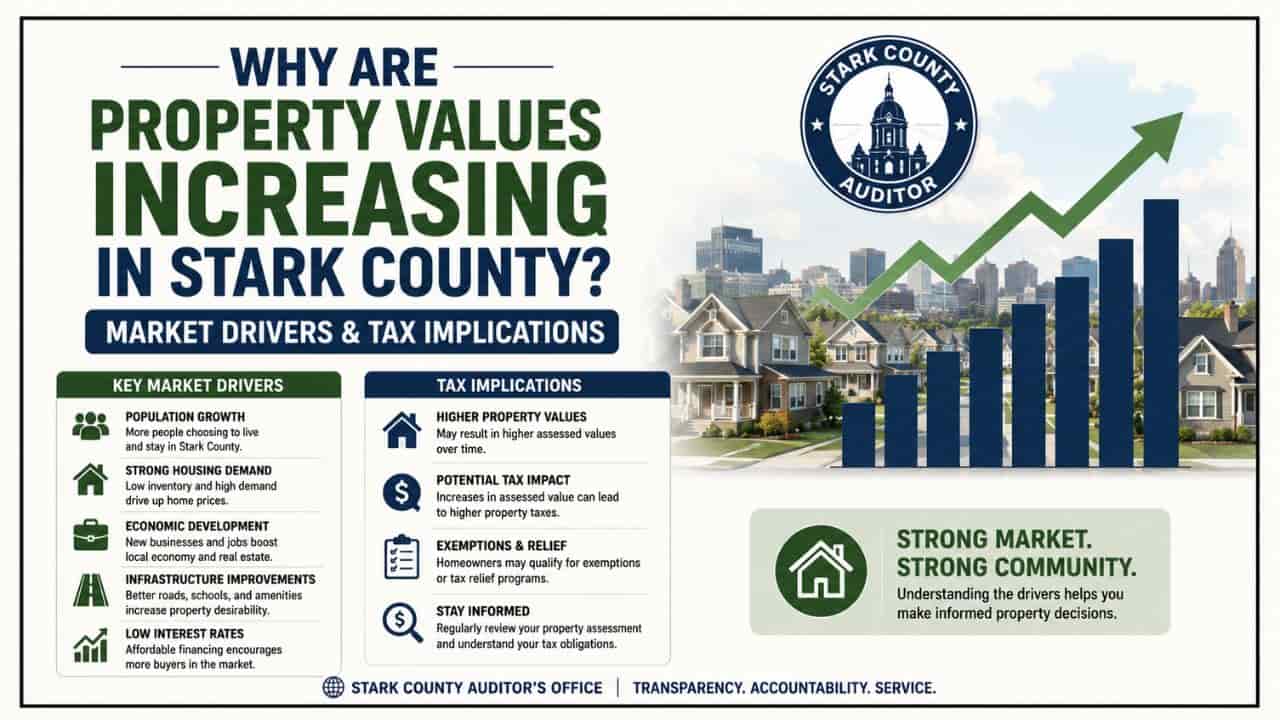
Real estate valuation changes on the Stark County property search portal follow a strict, statutory timeline known as the Sexennial Reappraisal and Triennial Update cycle. These state-mandated evaluations directly impact your annual property tax footprint across Ohio. Managed locally by the Stark County Auditor’s Office, this dual-track system ensures that property assessments remain uniform and aligned with actual open-market realities across all townships. This expert guide breaks down the legal framework of these tax cycles, explains statistical updates versus physical appraisals, and outlines your right to a formal appeal.
The Legal Mandate and the Stark County Auditor’s Role
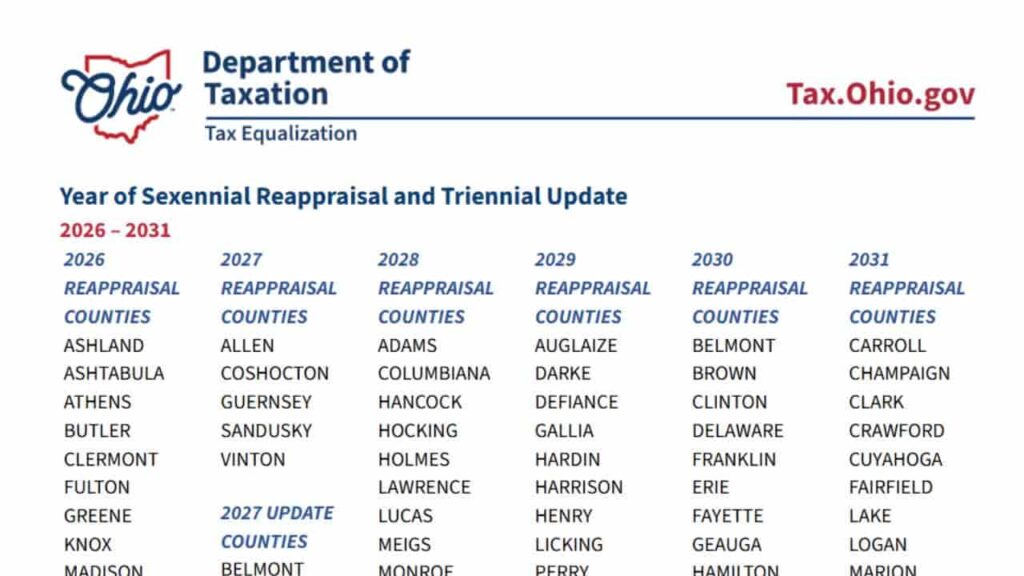
Under Ohio Revised Code Section 5715.33, every county auditor across Ohio’s 88 counties must conduct a complete reappraisal of all real property every six years. To keep the system fair between these massive adjustments, the law also requires a statistical market refresh exactly three years after the full reappraisal.
As the chief fiscal officer and assessor for Stark County, the Stark County Auditor is legally responsible for managing this process. The Auditor’s office does not create real estate market value; instead, it acts as an official evaluator, analyzing local home sales, commercial developments, and neighborhood trends to calculate the fair market value of every local land parcel.
[Stark County 6-Year Valuation Timeline]
├── Year 1: Full Sexennial Reappraisal (In-depth review of every parcel)
├── Year 2: Normal Tax Year (Values hold, unless new construction occurs)
├── Year 3: Normal Tax Year (Values hold)
├── Year 4: Triennial Update (Statistical adjustment based on local sales)
├── Year 5: Normal Tax Year (Values hold)
└── Year 6: Normal Tax Year (Values hold, preparing for next cycle)
Sexennial Reappraisal vs. Triennial Update: Core Differences
Property owners often confuse these two real estate evaluation events. While both can alter your property’s assessed value, their scope, methods, and processing scales are entirely different.
| Valuation Metrics | Sexennial Reappraisal (Every 6 Years) | Triennial Update (Every 3 Years) |
| Primary Method | Full, comprehensive field reviews, digital aerial imaging, and structural data verification. | Purely statistical mass appraisal and neighborhood sales ratio analysis. |
| Data Scope | Examines individual property traits like square footage, building materials, and additions. | Analyzes broader market changes across localized neighborhoods using past 3-year sales data. |
| Physical Inspections | Field appraisers actively verify property structures and site conditions. | No physical site visits required; assessments are strictly data-driven. |
The Sexennial Reappraisal: A Deep Architectural Audit
During a Sexennial Reappraisal year, the Stark County Auditor’s Office performs a deep audit of every residential, agricultural, commercial, and industrial property. Appraisers review updated geographic information system (GIS) mapping, evaluate building permits, and use advanced mass appraisal algorithms. This process updates individual property profiles by factoring in wear-and-tear, neighborhood improvements, and layout changes.
The Triennial Update: A Localized Market Adjuster
The Triennial Update occurs exactly midway through the six-year cycle. The Auditor does not look at individual homes or specific building characteristics. Instead, the office tracks valid, arms-length real estate transactions that occurred within your neighborhood over the preceding three years.
If market data reveals that home prices in a specific Canton township or Massillon neighborhood rose by an average of 15%, the Auditor applies a corresponding statistical percentage update to all similar properties in that area to keep assessments accurate to current market conditions.
Market Data Analysis: Calculating Fair Market vs. Assessed Value
To understand how these valuation updates influence your finances, you must understand how the State of Ohio calculates your taxable base. The property value system uses two distinct numbers:
- Fair Market Value (100%): This represents the estimated dollar amount your property would sell for on the open real estate market between a willing buyer and a willing seller.
- Assessed Value (35%): In Ohio, property taxes are not calculated using 100% of your market value. Instead, the statutory taxable baseline known as the assessed value is set at exactly 35% of your fair market value.
Assessed Value Formula:
Fair Market Value x 0.35 = Assessed Value (Taxable Footprint)
For example, if the Stark County Auditor determines your home’s fair market value is $200,000 following a Triennial Update, your taxable assessed value is calculated as follows:
$200,000 x 0.35 = $70,000
Your local voter-approved millage rates are then applied directly to this $70,000 figure to determine your annual tax bill.
How House Bill 920 Protects Taxpayers from Value Spikes
A common misconception is that a 20% increase in your property’s value automatically triggers a 20% increase in your property tax bill. Thanks to a landmark Ohio constitutional amendment passed in 1976 known as House Bill 920 (HB 920), this is not how the system works.
HB 920 protects property owners by automatically rolling back tax rates when property values rise due to market inflation or revaluation cycles. This legislative buffer ensures that local school districts and municipalities cannot collect more revenue from existing voted levies than what voters originally approved.
[How HB 920 Stabilizes Voted Levies]
Property Values Across Neighborhood Go UP ↑
───────────────────────────────────────────
Tax Reduction Factors Automatically Kick In
───────────────────────────────────────────
Effective Voted Millage Rates Go DOWN ↓
===========================================
Result: School District Collects Same Fixed Revenue Base
However, HB 920 protection does not apply to “inside millage,” which refers to the first 10 mills of property tax mandated by the Ohio Constitution that do not require voter approval. As a result, while your total tax increase is significantly limited by state law, you may still see a modest rise in your tax bill due to these unvoted inside mills.
Action Plan: What to Do If You Disagree with the Auditor’s Valuation
When the Stark County Auditor updates property values, property owners receive an official valuation change notice in the mail. If you believe the Auditor’s new market value estimation is higher than what your property would actually sell for on the open market, you have the right to challenge it.
Step 1: Participate in Informal Reviews
When new values are first announced during a Sexennial Reappraisal or Triennial Update year, the Stark County Auditor holds informal public consultation windows. Property owners can schedule a one-on-one meeting with the Auditor’s appraisal staff to present clear evidence such as a recent independent appraisal, structural damage reports, or closing statements to request an immediate administrative correction.
Step 2: File a Formal Complaint with the Board of Revision (BOR)
If informal channels do not resolve the issue, you can file a formal valuation appeal. You must submit Form DTE 1 (Complaint Against the Valuation of Real Property) to the Stark County Board of Revision.
[Formal BOR Appeal Process Timeline]
├── Filing Window: Open from January 1st until the strict March 31st deadline.
├── Evidence Submission: Provide closing statements, certified appraisals, or photos of damage.
└── The Hearing: Present your case in person before a three-member county panel.
The Board of Revision composed of the County Auditor, the County Treasurer, and the President of the Board of County Commissioners will evaluate your evidence and determine whether to adjust your property’s taxable footprint.
Conclusion
Understanding the structured cadence of Sexennial Reappraisals and Triennial Updates helps strip away the confusion surrounding Ohio property taxes. By distinguishing between the physical inspections of a full reappraisal and the data-driven adjustments of a triennial update, you can better anticipate shifts in your home’s valuation. Armed with this knowledge and protected by House Bill 920, you are well-prepared to monitor your property’s status, utilize the tools provided by the Stark County Auditor, and protect your financial interests.
FAQs
How often does Stark County update real estate property values?
Under Ohio law, property values are updated every three years, alternating between a comprehensive full Sexennial Reappraisal and a purely statistical Triennial Update.
What is the main difference between a reappraisal and a triennial update?
A reappraisal involves an in-depth review of each individual property, including physical and digital data checks. A triennial update is a data-driven adjustment based strictly on recent neighborhood sales trends.
If my Stark County property value increases by 30%, will my taxes go up by 30%?
No. Thanks to House Bill 920, tax reduction factors automatically lower voted millage rates when market values rise, protecting your tax bill from scaling directly with property inflation.
What is the difference between fair market value and assessed value in Ohio?
Fair market value is your home’s estimated total worth on the open market. Assessed value is the taxable base fixed by Ohio law, calculated as exactly 35% of the fair market value.
How can I contest a new property valuation set by the Stark County Auditor?
You can challenge a valuation by filing a formal complaint via Form DTE 1 with the Stark County Board of Revision between January 1st and the strict deadline of March 31st.