Rising real estate obligations across Ohio can place severe structural strain on military veterans relying on fixed disability allotments. To honor their service, the State of Ohio provides a significant financial safety net through an enhanced property tax reduction program. Commonly known as the Disabled Veteran Homestead Exemption, this statutory framework allows eligible veterans to shield a substantial portion of their home’s market worth from local municipal assessments. This comprehensive guide details eligibility criteria, eliminates common income verification myths, and provides a step by step roadmap to file your application with the Stark County Auditor’s Office.
The Administrative Role of the Stark County Auditor
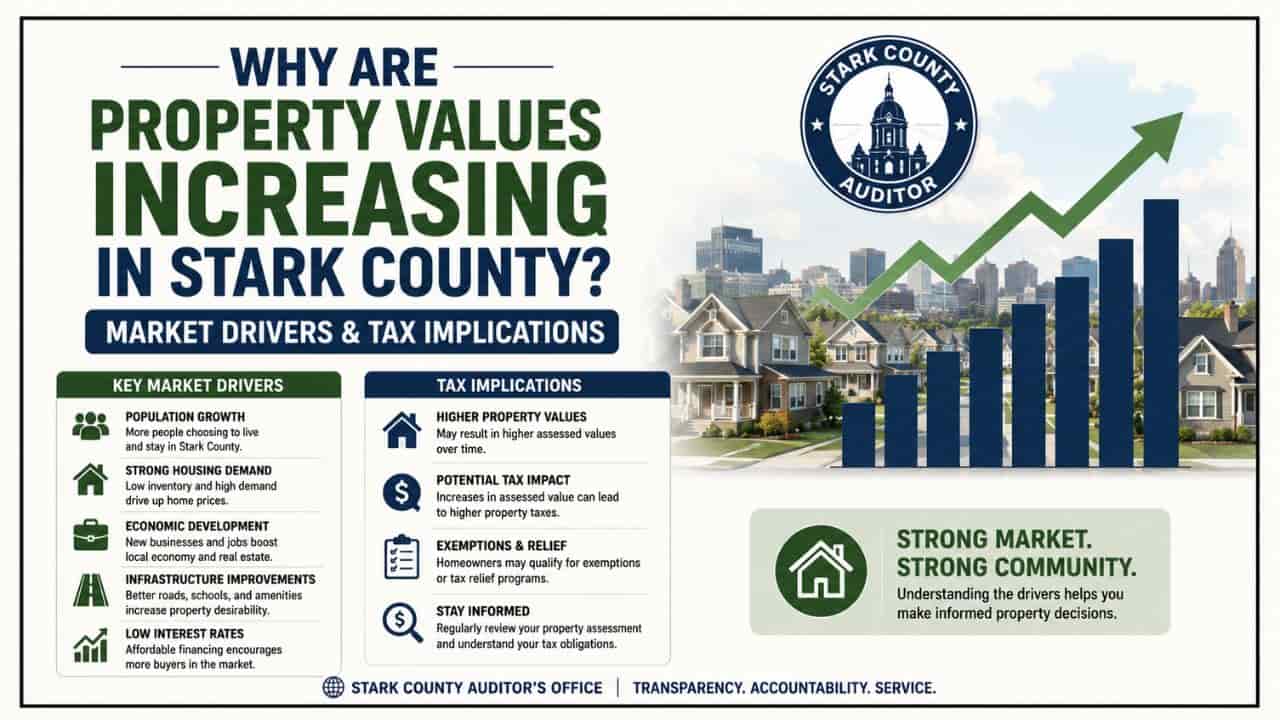
In Ohio, property tax administration and relief processing are managed at the county level. While the state legislature sets the structural guidelines for military tax exemptions, the Stark County Auditor’s Office is legally responsible for implementing these benefits locally. As the county’s chief assessor, the Auditor maintains the public real estate tax duplicate and applies all legal homestead credits to individual parcel accounts.
When a veteran submits an exemption package, the Auditor’s Real Estate Division evaluates the deed structure and validates the accompanying federal discharge files. Once approved, the Auditor adjusts the property profile, ensuring local school district, township, and city millage rates are multiplied against a significantly lower taxable base.
Standard vs. Enhanced Homestead Exemption
It is critical to distinguish between the standard homestead program designed for civilian seniors and the specialized, enhanced framework legislated explicitly for disabled military personnel. The structural differences between these two tracks impact both financial savings and eligibility criteria.
| Exemption Parameters | Standard Homestead Track | Enhanced Disabled Veteran Track |
| Market Value Tax Credit | Exempts the first $29,000 of market value from local taxation. | Exempts the first $58,000 of market value from local taxation. |
| Income Means Testing | Strict limit; household income cannot exceed $41,000. | No Income Restrictions; veterans qualify regardless of wealth. |
| Age Limitations | Must be at least 65 years old (unless fully disabled). | No Age Restrictions; open to any young or retired veteran. |
Understanding the Financial Impact
The enhanced tier doubles the standard reduction amount. By exempting $58,000 of appraised market value from taxation, a home valued by the Stark County Auditor at $150,000 will be billed as if it is worth exactly $92,000.
The exact dollar amount saved varies depending on the voter-approved millage rates within your local taxing district (such as Canton, Massillon, or Alliance), but it frequently reduces annual property tax obligations by hundreds of dollars.
Core Eligibility Criteria for Veterans
To secure the enhanced $58,000 exemption, an applicant must satisfy clear statutory benchmarks established under the Ohio Revised Code as of January 1st of the application year:
1. Military Discharge Status
The applicant must be a veteran of the United States Armed Forces, including reserve components or the National Guard, who was discharged or released from active duty under honorable conditions.
2. Disability Rating Metrics
The veteran must meet one of the following two strict conditions certified by the federal government:
- Have received a permanent and total (100% P&T) service-connected disability rating from the Department of Veterans Affairs (VA).
- Be receiving 100% disability compensation from the VA based on a formal determination of Individual Unempolyability (TDIU).
3. Ownership and Residency Rules
The veteran must own the real estate parcel either individually, as a life tenant, or through a qualifying trust and occupy the home as their primary, principal place of residence on January 1st of the application year. The exemption applies to the principal dwelling structure and up to one acre of surrounding land.
Step by Step Verification and Application Process
Filing for the veteran’s enhanced property tax reduction requires gathering specific federal records and completing the correct state form. Follow these step-by-step verification instructions to ensure error-free data processing.
Step 1: Secure Your Federal Documentation
Before downloading county paperwork, you must obtain certified copies of your military history logs. The Stark County Auditor cannot approve an application without these attachments:
[Mandatory VA Verification Document Package]
├── Component 1: Defense Department Form DD214 (Showing Honorable Discharge)
└── Component 2: Official VA Summary Benefits Award Letter (Confirming 100% P&T / TDIU)
1. The DD214: Locate your official Certificate of Release or Discharge from Active Duty (Form DD214). Ensure the “Character of Service” field explicitly states Honorable.
2. The VA Award Letter: Request a current Summary Benefits Letter from the Department of Veterans Affairs portal. This letter must explicitly state that your service-connected disabilities are rated at 100% or that you receive 100% compensation due to individual unemployability.
Step 2: Complete Form DTE 105I
Download Form DTE 105I (Homestead Exemption Application for Disabled Veterans and Surviving Spouses) directly from the official county server.
- Section 1: Print your legal name, current mailing address, and primary contact phone number.
- Section 2: Input your unique Stark County Parcel ID number and physical site address exactly as it appears on your official county real estate property card.
- Section 3: Check the box indicating whether you are applying as a veteran with a 100% disability rating or via Individual Unemployability.
Step 3: Package and Submit the Application
Sign and date the document under penalty of perjury. Combine the signed Form DTE 105I with photocopies of your DD214, VA benefits letter, and a valid Ohio driver’s license or State ID.
Real property applications can be submitted to the county starting the first Monday in January. The absolute filing deadline is December 31st of the application year.
Protections for Surviving Spouses
Ohio legislative codes contain critical safety extensions designed to protect the families of deceased military personnel. If a veteran was receiving the enhanced homestead exemption in Stark County prior to passing away, the tax reduction does not automatically vanish.
The surviving spouse can retain the full $58,000 tax credit provided they satisfy three administrative rules:
- They were legally married to the veteran at the time of death.
- They occupied the home as their primary residence when the veteran passed away.
- They acquire legal ownership of the homestead property and do not remarry.
To transfer the benefit, the surviving spouse must file Form DTE 105I under their own name, accompanying the request with the veteran’s death certificate and the initial VA disability documentation.
Local Administrative Office Resource Information
For military personnel who require in-person assistance, wish to submit physical records, or need help locating an ambiguous parcel ID number, visit the administrative offices downtown:
- Office Name: Stark County Auditor’s Office (Real Estate & Homestead Division)
- Physical Address: 110 Central Plaza South, Suite 220, Canton, OH 44702
- Direct Help Line: 330-451-7323
By executing these verification steps and maintaining clear documentation with courthouse officials, disabled veterans can easily claim the property tax relief they have earned through their service.
Conclusion
Securing the Stark County Disabled Veterans Property Tax Exemption is a straightforward process designed to provide meaningful financial relief to our nation’s heroes. Because this enhanced homestead program bypasses all age and income means testing, qualifying 100% disabled veterans can easily claim their exemptions. By submitting a complete application package with your DD214 and VA award letters to the Stark County Auditor, you can permanently lower your taxable property base and protect your home.
FAQs
Do disabled veterans have to pay property taxes in Stark County, Ohio?
Qualifying disabled veterans do not receive complete tax elimination, but they receive an enhanced homestead exemption that removes the first $58,000 of their home’s market worth from local taxation.
Is there an income limit for the Stark County veteran property tax exemption?
No. Unlike the standard civilian senior reduction, the enhanced Stark County veteran property tax exemption has no income limits or means-testing requirements.
Which form must a disabled veteran file with the Stark County Auditor?
Veterans must complete and submit Form DTE 105I (Homestead Exemption Application for Disabled Veterans) to the Auditor’s office in downtown Canton.
Can a veteran with a 90% VA disability rating receive the enhanced exemption?
No. To qualify for the enhanced $58,000 credit, the Stark County Auditor requires a 100% permanent and total (P&T) rating or proof of 100% compensation based on Individual Unemployability (TDIU).
Can a surviving spouse keep the veteran property tax reduction?
Yes. An eligible surviving spouse can continue receiving the tax break until they pass away or remarry, provided they own and live in the home.