When real estate owners fail to settle municipal liabilities, outstanding debt shifts into formal legal enforcement tracks. In Stark County, Ohio, this transition relies on two statutory tools: Tax Certificate Sales and Tax Foreclosures. While both systems recover lost revenue for local subdivisions, they operate under completely different legal frameworks and timelines under the joint authority of the Stark County Treasurer and Auditor. This professional guide details the strict parameters governing tax certificate transfers, outlines private foreclosure actions, and highlights specific county roles to protect your assets.
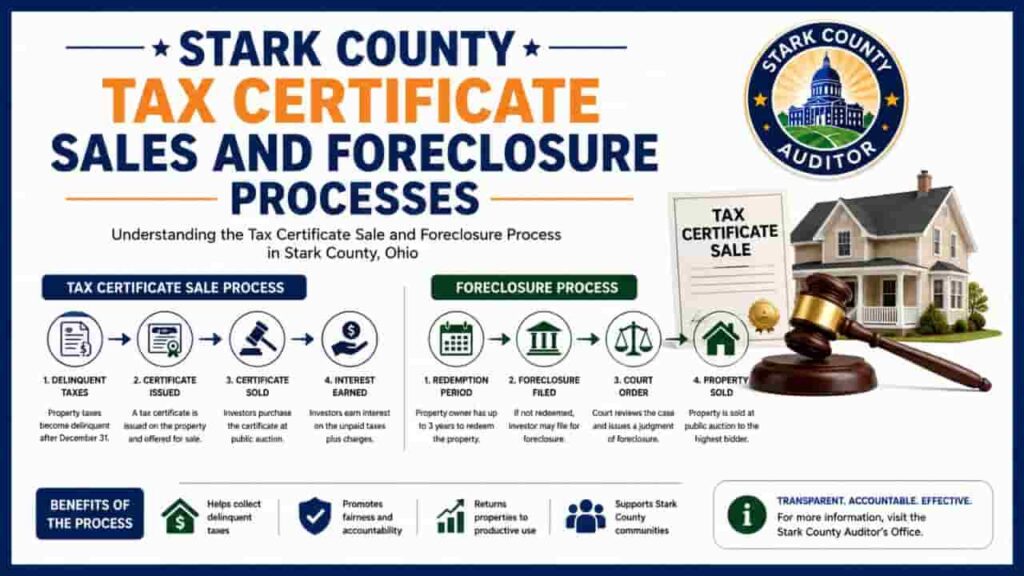
The Core Administrative Split: Auditor Certified Logs to Treasurer Lien Executions
To understand how a property moves onto the tax auction block, it is essential to trace the data flow between county departments. The legal process begins with financial reporting and asset valuation, divided along precise statutory lines:
[The Delinquent https://starkcountyauditor.online/property-search-by-owner-name/]
 ├── Stark County Auditor ──────► Reviews duplicate logs, adds penalties, and certifies the Delinquent Land List.
 └── Stark County Treasurer ────► Publishes the certified list, manages tax certificate sales, and coordinates foreclosures.
The Stark County Auditor maintains the master tax duplicate and evaluates property conditions. At the end of the yearly reconciliation period, the Auditor identifies properties with unpaid balances, applies mandatory statutory interest penalties, and officially certifies the Delinquent Land List.
Once this list is certified, custody shifts to the Stark County Treasurer. The Treasurer’s office acts as the collector, publishing the delinquent records, holding tax certificate auctions, and working with the Stark County Prosecutor’s Office to launch formal tax foreclosures.
Tax Certificate Sales vs. Standard Tax Foreclosures
Many real estate investors and property owners confuse a tax certificate sale with a physical property foreclosure auction. In Ohio law, these represent completely separate legal steps.
Tax Certificate Sales (Lien Purchases)
A tax certificate sale does not sell the physical land or transfer real estate ownership. Instead, the Stark County Treasurer sells the county’s first-priority tax lien to a private investor or institutional buyer. The investor pays the county the full amount of back taxes, fees, and interest due on the parcel. In return, they receive a Tax Certificate, which grants them the legal right to collect high statutory interest rates directly from the property owner during the redemption window.
Standard Tax Foreclosures (Property Purchases)
A tax foreclosure is a formal civil lawsuit filed in the Stark County Common Pleas Court. This action seeks to terminate the owner’s equity of redemption entirely. If the court rules in favor of the county or certificate holder, an order of sale is issued, and the physical real estate is auctioned off to the highest bidder to satisfy the outstanding tax debt.
Structural Tracking Framework
| Enforcement Parameter | Tax Certificate Sale (Lien Track) | Delinquent Tax Foreclosure (Property Track) |
| What is Being Sold? | The county’s first-priority tax lien certificate; no physical real estate transfers ownership. | The actual physical real estate and title deed; ownership transfers completely. |
| Auction Location / Type | Managed online via specialized platforms or via private regional institutional sales. | Conducted live by the Sheriff’s Office on the first Tuesday of each month at 110 Central Plaza South. |
| Minimum Bid Baseline | Equal to the exact amount of certified delinquent taxes, assessments, and accrued interest penalties. | Calculated by the Prosecutor’s Office to cover all taxes, court costs, and legal filing fees. |
The Legal Lifeline: The Property Owner’s Right of Redemption
Once the Auditor certifies a parcel as delinquent and the Treasurer sells a tax certificate, the property owner enters a critical legal window known as the Redemption Period. Under Ohio Revised Code Chapter 5721, the owner retains full legal title and possession of the property during this time. Bidders and certificate holders are strictly prohibited from trespassing, entering, or altering the real estate.
To clear the lien and protect their title, the property owner must execute a formal Tax Redemption:
- Pay Total Payoff Delinquency: The owner must pay the full amount of the tax certificate plus all accrued interest fees directly to the Stark County Treasurer’s Office.
- Lien Release: Once the Treasurer processes the redemption payment, the private investor’s tax certificate is canceled, the funds are passed to the certificate holder, and the clean status is updated on the Auditor’s property duplicate logs.
If the property owner fails to redeem the tax certificate within the statutory timeline (typically one to three years after the certificate is sold), the private investor gains the legal right to hire an attorney and trigger a formal tax certificate foreclosure action.
The Mechanics of Tax Certificate Foreclosures
When a property remains unredeemed, the certificate holder can transition the lien into a real estate acquisition through a Tax Certificate Foreclosure. This process follows strict procedural requirements:
[Tax Certificate Foreclosure Milestones]
  Step 1: Private Attorney files a foreclosure complaint based on the unredeemed certificate.
  Step 2: Case proceeds through Common Pleas Court; Judge signs Confirmation of Sale.
  Step 3: Property is auctioned online via Realauction on a scheduled Monday at 10:00 AM.
  Step 4: Winning bidder submits a 10%, 5k, or 10k deposit; remaining balance is due within 30 days.
Key Auction Rules for Buyers
Unlike standard monthly county tax sales, tax certificate foreclosures follow specific online protocols:
- The Bidding Platform: These specialized auctions are conducted digitally on the “Official Public Sheriff’s Sale Website” managed by Realauction. Auctions run on Mondays starting at 10:00 a.m. Eastern Time.
- No Property Appraisals: Properties sold through tax certificate foreclosures do not undergo an independent appraisal. The minimum starting bid is established by the private attorney representing the plaintiff.
- As-Is Title Transfers: All sheriff sales are executed strictly on an “As-Is” basis. The county does not guarantee a clear title deed. Bidders must complete an independent title search via the Stark County Clerk of Courts online docket before participating to check for competing junior liens or civil claims.
Local Administrative Records and Assistance Channels
Property owners looking to settle an outstanding balance, or investors researching upcoming certificate sale lists, can verify records directly through local county channels:
- Office Name: Stark County Treasurer’s Office (Delinquent Tax Division)
- Physical Location: 110 Central Plaza South, Suite 250, Canton, OH 44702
- Legal Inquiries: Case file records, title documents, and active foreclosure pleadings can be viewed at the Clerk of Courts Office inside the County Courthouse from 8:30 a.m. to 4:30 p.m. daily.
- Blighted / Vacant Alternatives: If a delinquent parcel fails to sell at auction twice, it may be transferred directly to the Stark County Land Bank (Stark County Land Reutilization Corporation) to be cleaned up and returned to productive use.
Conclusion
Navigating Stark County tax certificate sales and foreclosure actions requires close attention to Ohio’s real estate statutes. From the moment the Stark County Auditor certifies the delinquent land list, a clear legal clock begins ticking. Property owners must act quickly during their redemption window to prevent private certificate holders from initiating a foreclosure lawsuit. At the same time, real estate investors must carefully evaluate title records and follow Realauction bidding guidelines to successfully acquire these properties. Understanding these legal frameworks protects your capital and helps you make informed decisions in the local real estate market.
FAQs
Can I lose my home immediately after a Stark County tax certificate is sold?
No. Buying a tax certificate only transfers the tax lien, not property ownership. You retain full legal title to your home and can clear the debt by paying off the balance during your redemption window.
What is the main difference between a monthly tax sale and a tax certificate foreclosure?
Monthly tax sales are handled in-person by the county for unpaid taxes. Tax certificate foreclosures are filed online by private certificate holders via the Realauction platform on Mondays.
Are properties sold through Stark County tax certificate foreclosures appraised?
No. These properties do not go through an appraisal process. The minimum starting bid is set by the private attorney representing the certificate holder.
How much time do I have to pay the remaining balance if I win an online certificate foreclosure auction?
You must pay the remaining balance within 30 calendar days from the date the final sale entry is confirmed by the Clerk of Courts. Extensions are not allowed.
Where can I look up active tax foreclosure lawsuits and title filings in Stark County?
You can review active cases on the Stark County Online Case Docket via the Clerk of Courts portal to view title work, junior liens, and legal claims.