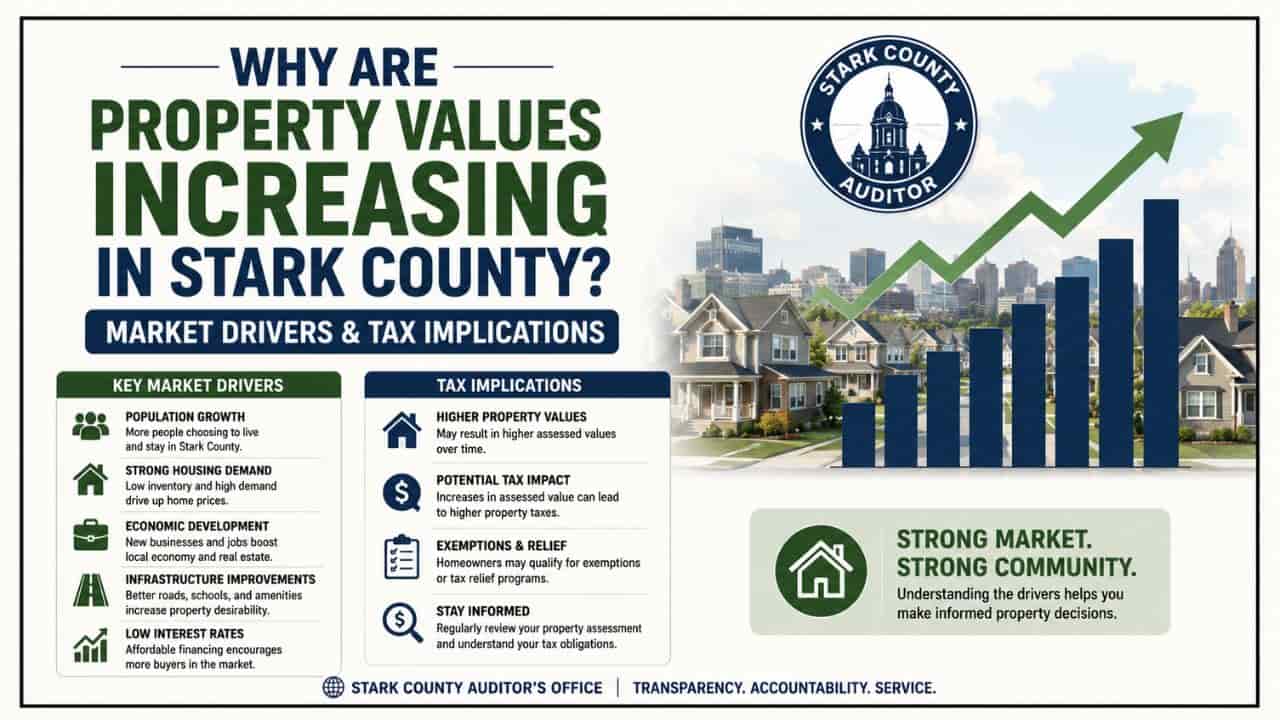
For property owners and entrepreneurs across Canton, Massillon, and Alliance, Understanding municipal operations can be challenging. In Ohio’s local tax framework, the Stark County Auditor serves as both Chief Assessment Officer and Chief Fiscal Officer. While the Treasurer exclusively collects payments, the Auditor evaluates real estate market values, calculates millage rates, manages public regional payroll funds, and issues mandatory commercial vendor licenses. This expert guide breaks down these statutory administrative responsibilities step by step, helping you understand official county property valuations, protect your real estate equity, and maintain regulatory business compliance.
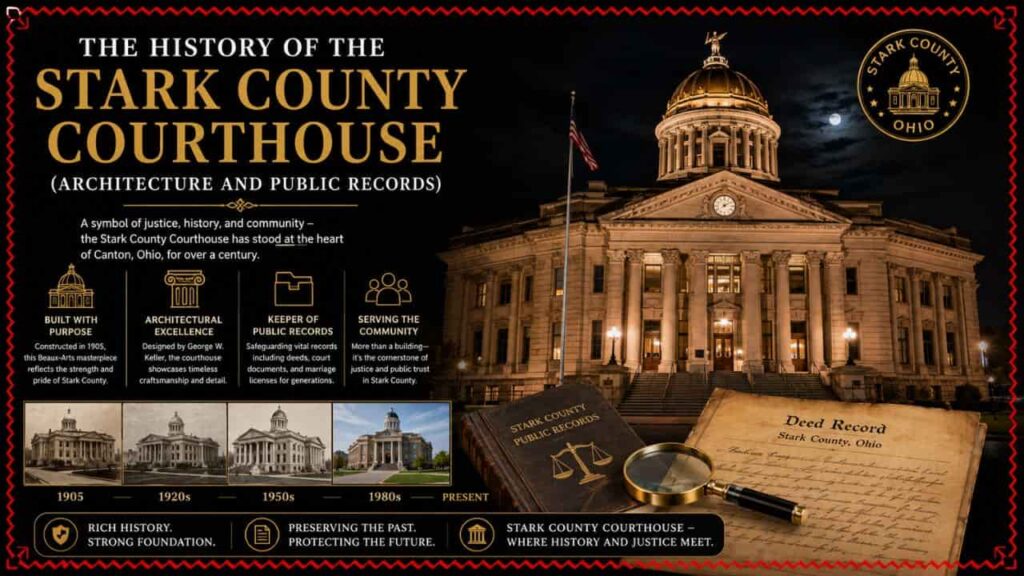
1. The Evolution of Justice: A Historical Overview of Stark County Courthouses
The story of Stark County’s justice system began in 1808 when the county was formed, officially designating Canton as the county seat. In 1816, Bezaleel Wells, the visionary founder of Canton, sold a prominent plot of land at the corner of Tuscarawas Street and Market Avenue to the county commissioners for a symbolic ten dollars. On this designated public space, the first courthouse a simple, forty-four-foot square brick federal-style structure topped with an elegant cupola was completed in 1818. To accommodate the region’s rapid development, a dedicated brick annex was added in the 1840s to house expanding administrative divisions and county offices.
By the post-Civil War era, the county’s commercial and industrial boom demanded a more robust administrative center. In 1870, the original brick structure was replaced by an Italianate-style courthouse designed by Cleveland architect Henry E. Myers. This second structure served as the structural foundation for the building we see today. Between 1893 and 1895, local leaders commissioned a dramatic expansion rather than a costly demolition. Cleveland-based contractor George F. Hammond and architect John Milton Dyer successfully constructed a larger, modernized Beaux-Arts courthouse directly around the brick shell of the existing 1870 building, securing a seamless architectural bridge between generations.
2. Beaux-Arts Architecture: Design and Notable Symbols
The resulting structure is a masterpiece of Beaux-Arts Classicism, an architectural style highly popular during the Gilded Age. This style is characterized by heavy ornamentation, symmetrical facades, and classical Greek and Roman structural elements. The courthouse is constructed of premium granite and buff-colored Ohio sandstone, projecting a sense of civic pride across the downtown Canton landscape.
The Trumpeters of Justice
The most dramatic feature of the courthouse’s exterior is the clock tower, which stands prominently at the northeast corner. This tower is famously crowned by four copper-clad statues known as the “Trumpeters of Justice.” Crafted in 1895, these larger-than-life figures depict trumpeting angels, symbolizing municipal authority and the public pursuit of truth. For over a century, these iconic guardians have watched over Canton’s central business district, serving as a familiar visual landmark for travelers along the historic Lincoln Highway.
The William McKinley Connection
The historical significance of the courthouse extends far beyond its stone walls, finding a deep connection with the 25th President of the United States, William McKinley. In 1867, McKinley established his legal practice in Canton, often litigating landmark cases within the walls of the second courthouse structure. Today, the courthouse retains the historic McKinley Room, preserving the legal archives, desks, and documents where the future president defended local citizens and refined his trademark oratory style.
3. The Civic Role of the Stark County Auditor & Public Records Preservation
While the courthouse is celebrated for its historic trial courtrooms, it also served as the primary historic repository for county records. Under the Ohio Revised Code, maintaining transparent public records is essential to protecting community equity and commercial investments. This is where the crucial administrative role of the Stark County Auditor intersects with the courthouse’s historical legacy.
While the modern Auditor’s team operates from the adjacent County Office Building, their comprehensive property databases are built entirely upon the historical legal baselines established within the historic courthouse. The Auditor serves as the Chief Fiscal Officer and Chief Assessment Officer, ensuring that property lines, historic plat boundaries, and tax values are meticulously archived.
The public records framework of Stark County is organized across three primary municipal entities:
- The Stark County Auditor: Manages historic parcel maps, land tax valuations, GIS spatial mapping files, and statutory tax relief programs like the Homestead Exemption.
- The Stark County Recorder: Archives physical transfer deeds, historical mortgages, and structural property liens dating back to the county’s founding in 1808.
- The Stark County Clerk of Courts: Preserves felony criminal records, civil dockets, marriage license files, and historical probate documents.
4. Understanding the Historical Records: A Three-Column Comparative Table
To help local researchers navigate these historical resources efficiently, the table below compares the primary historical records, their custodians, and access channels:
| Record Classification | Primary Administrative Custodian | Public Access Channel & Use Case |
|---|---|---|
| Historical Deeds | Stark County Recorder | Searchable online via the official Recorder’s index; used to verify chain of title. |
| Tax Valuation Maps | Stark County Auditor | Accessed on the digital Real Estate Search portal; shows parcel lines and tax valuations. |
| Court Dockets | Stark County Clerk of Courts | Retrieved at the local archives; used to track civil lawsuits and historical probate filings. |
5. Step-by-Step Guide to Retrieving Historic Public Records
Whether you are performing real estate due diligence or tracing family genealogy, locating historical files requires a methodical step-by-step approach:
- Extract Parcel Identification Numbers: Use the Stark County Auditor’s online geographic information system (GIS) maps to locate the target property and record its permanent parcel number.
- Cross-Reference the Transfer History: Take the parcel number to the Stark County Recorder’s physical or digital portal to view the chronological chain of ownership, tracking original handwritten deed books.
- Review Historic Judgments and Probate Files: If the title history shows an estate transfer, search the probate division archives managed by the Clerk of Courts to verify wills or partition actions.
- Confirm Modern Tax Valuations: Verify current tax assessment balances and historical levy details directly on the Auditor’s valuation portal to ensure no lingering administrative debts exist.
Conclusion
Preserving the rich architectural legacy and historic archives of the Stark County Courthouse remains a vital public service for Northeast Ohio. By understanding the structural milestones of this Beaux-Arts masterpiece and utilizing modern databases managed by the Stark County Auditor and Recorder, citizens can seamlessly trace local history. Protecting these historical public records secures transparent property ownership, preserves regional legal heritage, and strengthens community identity throughout Canton, Massillon, and Alliance.
FAQs
Where is the Stark County Courthouse located?
The historic Stark County Courthouse is located at 115 Central Plaza North, at the intersection of Market Avenue and Tuscarawas Street, in downtown Canton, Ohio.
Who designed the historic Stark County Courthouse?
The current Beaux-Arts style courthouse was designed by Cleveland architect George F. Hammond in 1895, utilizing the foundation and walls of the previous 1870 Italianate structure.
Who are the “Trumpeters of Justice” on the clock tower?
The “Trumpeters of Justice” are four majestic, larger-than-life copper-clad angels mounted on the corners of the courthouse clock tower, representing municipal authority and civic integrity.
How does the Stark County Auditor utilize courthouse history?
The Stark County Auditor references historical property boundaries, original land grants, and structural tax baselines established during the nineteenth century to maintain current municipal GIS parcel maps.
Are historical court records from the courthouse accessible online?
Yes. Real estate deeds are searchable via the Stark County Recorder’s online platform, while legal cases and dockets are maintained by the Stark County Clerk of Courts.