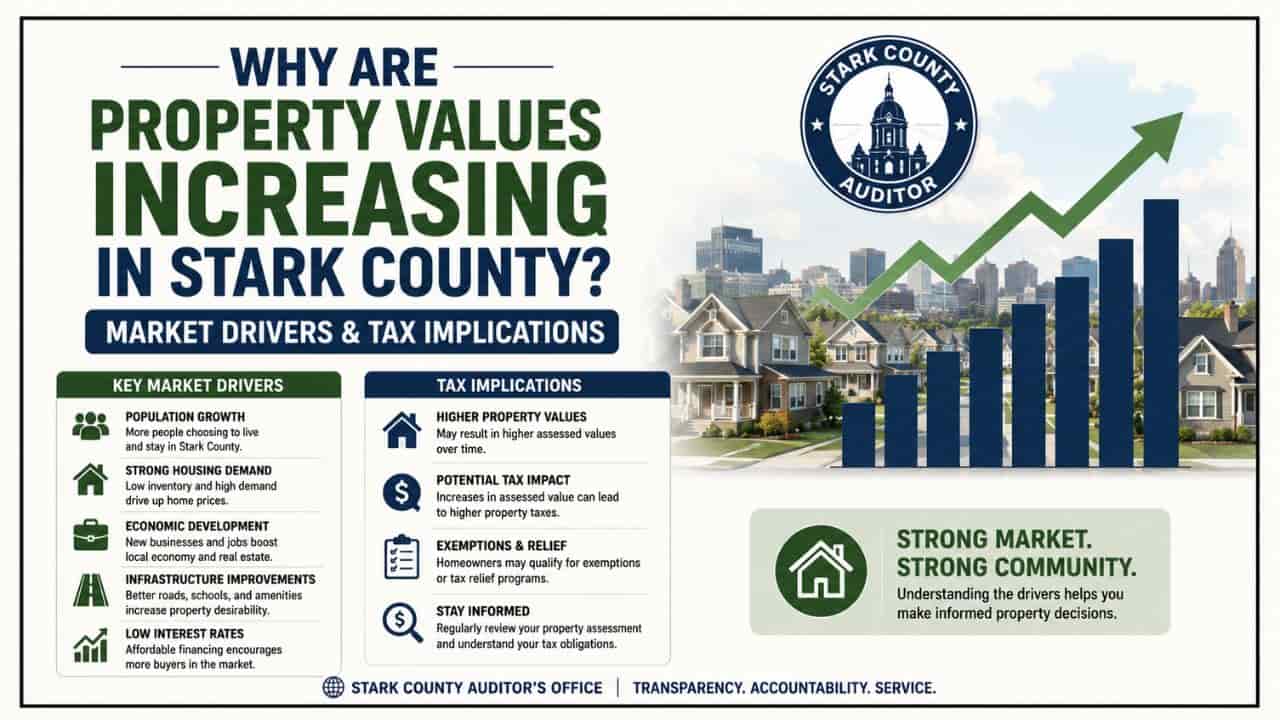
For homebuyers, real estate investors, and developers across Northeast Ohio, managing annual carrying costs is critical to protecting investment yields. In Stark County, property tax rates vary significantly depending on local school district levies and municipal boundaries. While the Stark County Treasurer collects these taxes, the Stark County Auditor serves as the Chief Assessment Officer, establishing parcel valuations and applying certified millage rates. This expert guide highlights the top local neighborhoods with the lowest property tax rates, helping you maximize your purchasing power across Canton, Massillon, Alliance, and surrounding rural townships.

1. Understanding Ohio’s Property Tax Framework
To identify the most tax-advantageous locations in Stark County, you must first understand how municipal real estate taxes are structured under the Ohio Revised Code (ORC). Property taxes in Ohio are not calculated directly from a home’s gross open-market value. Instead, they rely on a combination of computerized mass assessments, state-mandated assessment ratios, and voter-approved millage rates.
The 35% Assessment Ratio
In Ohio, your taxable value known as the Assessed Value is locked by law at exactly 35% of the appraised market value established by the Stark County Auditor.
Assessed Value = Appraised Market Value x times 0.35 $
For instance, if the Auditor values a single-family home in Lawrence Township at $200,000, the tax calculations are applied only to the assessed baseline of $70,000.
Understanding Millage Rates
Property tax rates are expressed in mills. One mill represents $1 of tax liability for every $1,000 of taxable assessed value. However, because of state-mandated rollback credits and House Bill 920 reduction factors, the “gross millage” voted on by the public is reduced to an “effective millage” rate to prevent inflation-driven tax hikes. The final annual tax before exemptions is calculated using this formula:
Annual Tax Owed = Assessed Value x Effective Millage Rate / 1000
2. Top Stark County Neighborhoods with the Lowest Property Tax Rates
In Stark County, the school district boundary is the single largest factor determining your annual property tax bill. Neighborhoods located in rural townships or served by school districts with lower voter-approved operating levies enjoy the lowest tax rates in the region.
Below is a detailed breakdown of the premier low-tax neighborhoods, townships, and specific school district configurations across Stark County.
| Taxing Jurisdiction & Neighborhood | Primary School District | Average Effective Tax Rate (%) |
|---|---|---|
| Alliance City (Marlington Zones) | Marlington Local School District | 1.22% |
| Washington Township | Marlington Local School District | 1.23% |
| Lexington Township | Marlington Local School District | 1.38% |
| Nimishillen Township | Marlington Local School District | 1.38% |
| Sugarcreek Township | Southeast Local School District | 1.43% |
| Canal Fulton City (Lawrence Twp) | Northwest Local School District | 1.45% |
| Tuscarawas Township | Tuslaw Local School District | 1.47% |
The Marlington District Corridors: Washington & Lexington Townships
Neighborhoods located within the Marlington Local School District boundaries boast some of the lowest effective tax rates in the county. Washington Township features rural residential estates where the effective tax rate is a remarkably low 1.23%. This means a property with a market value of $100,000 carries an annual tax bill of only $1,230. Similarly, Lexington Township offers peaceful, low-density neighborhoods with an effective rate of just 1.38%, making these areas highly attractive for long-term equity growth.
The Western Edge: Tuslaw and Tuscarawas Townships
If you prefer suburban and rural properties on the western edge of Stark County, Tuscarawas Township (served by the Tuslaw Local School District) is a standout option. Carrying an effective rate of 1.47%, neighborhoods here avoid the higher municipal infrastructure taxes found in nearby Massillon, while still providing rapid access to major commercial highways.
Hidden Value in Alliance City
While major cities like Canton often have higher tax rates due to urban school district demands, specific pockets of Alliance City that fall within the Marlington Local School District feature the absolute lowest municipal rate in the entire county at 1.22%. This rare combination provides municipal services alongside exceptionally low tax liabilities.
3. The Crucial Role of the Stark County Auditor in Tax Stabilization
The Stark County Auditor plays a fundamental role in managing and updating these rates. Under Ohio law, the Auditor acts as the Chief Assessment Officer and is responsible for maintaining fair and accurate property valuations across the county.
                  [Stark County Auditor]
                            |
           +----------------+----------------+
           |                                 |
           v                                 v
[Appraises Market Value]          [Applies Tax Reductions]
  (Six-Year Cycle &                  (Homestead, Owner-Occupancy,
   Triennial Updates)                 and CAUV Programs)
The Auditor’s office keeps tax rates stable through several vital administrative functions:
- The Sexennial Reappraisal: Conducted every six years, during which the Auditor’s team performs complete physical and structural market analyses of every real estate parcel in the county.
- The Triennial Market Update: A statistical adjustment occurring three years after the reappraisal to align county valuations with recent, localized real estate sales data.
- Administering Statutory Tax Reductions: The Auditor directly processes applications for the 2.5% Owner-Occupancy Credit, the Homestead Exemption for seniors and disabled residents, and the Current Agricultural Use Value (CAUV) program, which significantly lowers carrying costs for working farmland.
4. Step by Step Guide to Verifying and Optimizing Your Property Taxes
To secure the lowest possible tax footprint on your next real estate transaction in Stark County, follow this step-by-step verification process:
- Locate the Permanent Parcel Number: Visit the Stark County Real Estate Search portal and enter the property’s physical address to extract its official parcel ID.
- Identify the Tax District Code: Look up the property’s specific Tax District Number on the Auditor’s property card. This code determines the precise combination of township, city, and school district levies applied to the parcel.
- Use the Stark County Tax Estimator: Go to the Auditor’s online Tax Estimator Tool. Input your parcel number or select your target neighborhood to see how upcoming, voter-approved levies or bond issues will impact your future tax bills.
- Apply for Eligible Tax Exemptions: If you are purchasing a primary residence, verify that the Owner-Occupancy Credit is active on the account. If you qualify by age or income, submit a Homestead Exemption application directly to the Auditor’s office before the annual statutory deadline.
- File a Valuation Appeal if Necessary: If you purchase a property and believe the Auditor’s appraised market value is higher than actual market conditions, you have a legal right to challenge it. File a formal valuation complaint with the Stark County Board of Revision (BOR) between January 1 and March 31 to lower your taxable assessed value.
Conclusion
Minimizing your annual carrying costs in Northeast Ohio starts by strategically identifying the lowest tax districts. By analyzing certified millage rates, utilizing online databases, and validating your parcel records with the Stark County Auditor, you protect your primary home equity. Balancing school district levies with property valuations remains the ultimate strategy to secure maximum housing affordability and build lasting real estate wealth across Canton, Massillon, and Alliance successfully and safely.
FAQs
What is the lowest property tax area in Stark County?
The lowest property tax rates are found in parts of Alliance City, Washington Township, and Lexington Township, specifically within the Marlington Local School District boundaries.
How does a school district affect my Stark County property tax?
School district levies make up the largest portion of your property tax bill, meaning districts with lower operational funding voter-approved levies maintain much lower overall tax rates.
What role does the Stark County Auditor play in tax rates?
The Stark County Auditor establishes your property’s assessed market value and applies certified local millage rates to calculate your annual property tax liabilities.
What is a mill in Stark County tax terms?
A mill represents one dollar of tax for every one thousand dollars of your property’s assessed value, which is locked at thirty-five percent of market value.
Can I lower my property tax rate in Stark County?
You cannot change the tax rates, but you can lower your bill by filing valuation appeals with the Board of Revision or applying for active Homestead exemptions.